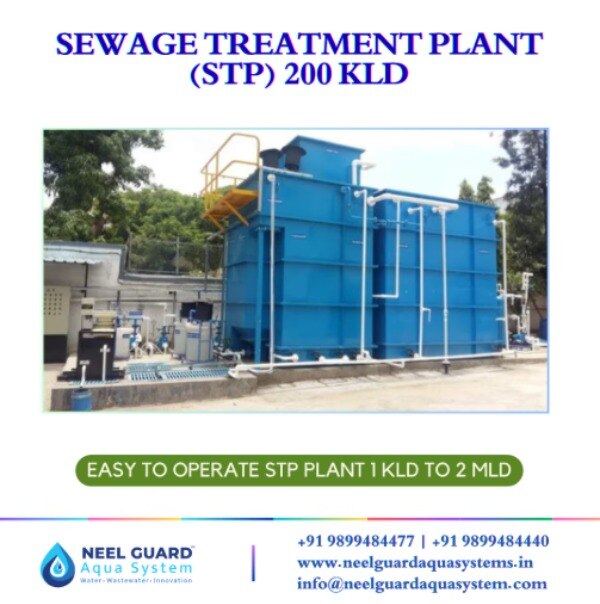
A 200 KLD nameplate describes average daily throughput, not the volume a facility can discharge in one burst or the pollutant load the biology can handle. To choose a plant that remains stable as occupancy or production grows, you need to measure actual flows, separate sewage from process wastewater, define the treatment train and tie performance guarantees to reuse, consent and monitoring requirements.
Key takeaways
- Measure average and peak inflow before selecting 200 KLD.
- Convert occupancy, water use and growth into daily design load.
- Keep industrial chemicals and shock loads out of biological treatment.
- Define outlet limits, records and operator responsibilities before commissioning.
Confirm the Facility’s Real Flow Before Choosing 200 KLD
A 200 KLD sewage treatment plant fits only when measured inflow, peak-hour flow rate and future demand support the selection. Its nameplate means an average design capacity of 200 m³/day, or 8.33 m³/h if flow arrives evenly; it does not mean the plant can accept 200,000 litres in one short discharge.
Run a daily inflow measurement programme for at least several representative days, including weekends, shift changes and high-occupancy periods. Record totalised flow every hour, note occupancy or production, and separate toilet, bathing, kitchen and laundry flows from process wastewater.
- Compare the highest daily total with 200 m³/day.
- Identify the maximum hourly inflow and short-duration discharge events.
- Add expected residents, staff, beds, guests or production output for the planning horizon.
- Check where supplied water is consumed through irrigation, cooling, RO reject, leaks or process use instead of reaching the sewer.
| Finding | What it means | Design response |
|---|---|---|
| Flow averages below 200 m³/day but arrives in sharp bursts | Rated capacity may hide hydraulic overload | Provide equalisation and controlled pumping; two hours of average flow alone represents about 16.7 m³ before allowances |
| Current flow approaches 200 m³/day | Little operating or growth margin remains | Increase capacity or reserve a defined expansion module |
| Industrial, oily, saline or chemical streams enter the sewer | Domestic biological treatment may be inhibited | Segregate streams and assess pretreatment or an ETP |
| Growth is expected | Current flow understates the future load | Reserve civil footprint, pipe headers, electrical capacity and access for additional treatment volume |
Also check BOD loading: 200 m³/day at 250 mg/L equals 50 kg BOD/day, while 150 mg/L equals 30 kg/day. Flow alone cannot define usable capacity.
Convert Occupancy, Water Use and Growth Into a Design Load
At 200 KLD, the hydraulic design basis is 200 m³/day average flow, not 200,000 litres discharged at once. Calculate wastewater flow from measured inlet volume, peak-hour flow and occupancy, then compare those figures with the plant rating and equalisation capacity.
Build the calculation from these inputs:
- Record daily inlet flow for at least several representative operating days, including weekends and high-occupancy periods.
- Calculate per-capita sewage generation as measured sewage flow divided by actual residents, staff, guests, beds or other users.
- Prepare a water balance covering supplied water, drinking and kitchen use, cooling-tower make-up, irrigation, RO reject, leaks and water retained in products or sludge.
- Apply the growth case: current users × projected occupancy or production, then add the measured per-capita sewage generation for that future load.
Do not convert supply into sewage by automatically multiplying it by 80%. That figure is a preliminary planning convention; irrigation, cooling losses, RO reject, infiltration and process use can move the wastewater fraction sharply.
Calculate BOD loading separately: flow in m³/day × influent BOD in mg/L ÷ 1,000 equals kg BOD/day. Thus, 200 m³/day at 250 mg/L produces 50 kg BOD/day, while the same flow at 150 mg/L produces 30 kg/day. Use measured samples or a defensible pollutant basis, because organic loading determines aeration, biological volume and sludge capacity.
Include future hydraulic and BOD loads in the supplier’s performance guarantee.
Control Peaks and Keep Industrial Wastewater Out of the Wrong Biology
A 200 KLD plant is rated for 200 m³/day on an average basis, or 8.33 m³/h if flow arrives evenly. It cannot safely accept 200,000 litres discharged within a few hours. Measure hourly inflow, identify morning and evening surges, and use peak flow control so pumps and biological tanks receive a steadier load.
Use the measured profile for equalisation tank sizing. Two hours at the average rate represents 16.7 m³ of working volume before adding allowance for peak balancing, unusable bottom volume and emergency storage.
Provide mixers or low-rate aeration, level instruments, minimum pumpable volume, overflow routing, odour control and cleaning access; a bare concrete volume will turn septic and odorous if solids settle.
Separate sewage versus industrial effluent at the collection point. Route each stream according to its likely interference with biology:
- Toilets, bathing and ordinary domestic wastewater: send to the STP after screening.
- Kitchen wastewater: pass through a correctly maintained grease trap before equalisation.
- Laundry chemicals, laboratory drains and disinfectant washes: collect and assess separately before discharge.
- RO reject, softener brine, oily water, solvents and concentrated process cleaning liquids: divert to an ETP, recovery system or approved disposal route.
Pretreatment protects the reactor from toxicity, grease, extreme pH and salinity. Install neutralisation, oil separation or chemical dosing only after testing the actual stream. Equalisation then blends compatible wastewater, but it does not reduce total pollutant mass or replace biological treatment capacity.
Compare the Treatment Process, Equipment and Future Expansion Plan
Compare the process against your wastewater pattern, outlet use and expansion plan—not against the 200 KLD label. Ask for design flow, peak flow, influent BOD and the resulting aeration volume, oxygen-transfer capacity and sludge-storage size. At 200 m³/day, 250 mg/L BOD equals 50 kg/day; 150 mg/L equals 30 kg/day.
| Process | Equipment to compare | Key trade-off |
|---|---|---|
| MBBR | Media-retention screens, aeration grid, blowers and continuous-flow tanks | Robust attached growth, but lost media can damage pumps and downstream equipment |
| SBR | Level sensors, programmable sequencing, decanter, blowers and sludge-return equipment | Handles batch operation, but decanter or control failure disrupts the cycle |
| MBR | Membrane modules, permeate pumps, air scour, backwash and cleaning systems | Produces high-quality water, but membrane fouling increases energy and maintenance |
Require screening and grit removal before pumps and biology. Check duty/standby capacity, automatic changeover, high-level alarms, manual override, power-failure response and spare-part availability for pumps, blowers, dosing units, decanters and disinfection equipment.
A credible expansion plan reserves civil and electrical space for extra equalisation, biological volume, tertiary filtration, sludge storage and odour control. Confirm that future modules have connection points on influent and treated-water headers, suitable hydraulic levels, control-panel capacity and clear access routes; otherwise a “modular” upgrade may require demolition.
NEEL GUARD AQUA SYSTEMS can be asked to show these items on the general arrangement drawing and equipment schedule, rather than leaving future capacity as a sales note.
Related product
 | SEWAGE TREATMENT PLANT (STP) SEWAGE TREATMENT PLANT 200 KLD ₹4500000 A 200 KLD (Kilo Liters per Day) Sewage Treatment Plant is a medium-to-large capacity system designed to treat wastewater from residential societies,... View product → |
Set Outlet Quality, Compliance Records and Operating Responsibilities
A 200 KLD label does not define acceptable outlet water. Tie the specification to its destination: treated-water reuse for toilet flushing, irrigation, cooling make-up or process use requires the quality stated by the end user and the State Pollution Control Board consent; discharge requires the consent condition for that receiving location.
State guaranteed values for BOD, COD, TSS, ammonia, pH and faecal coliform, plus nitrogen, phosphorus or residual chlorine when applicable.
Put these conditions in the purchase contract:
- Name the applicable consent, notification or approval, not an unqualified claim such as “as per CPCB norms.”
- State influent ranges, minimum and maximum flow, temperature, pH, BOD, COD, TSS and ammonia.
- Identify the sampling point, operating hours, test method, laboratory requirement and response to shock loads.
- Define the consequence when the guaranteed outlet value is missed.
Assign one operator to record flow, pH, chemical dosing, aeration, power interruptions, sludge wasting and daily abnormalities. Test at the frequency stated in the consent and retain laboratory reports, calibration records, maintenance logs and inspection correspondence. UV needs low turbidity and adequate UV transmittance; chlorination needs controlled dosing, contact time and residual checks.
Sludge handling belongs in the operating plan, not at handover. Provide capacity for sludge holding, thickening or dewatering, cake storage and nuisance control, then send sludge to an authorised destination with transport and disposal records. A compliant liquid outlet does not excuse unmanaged sludge.
Frequently asked questions
How do you confirm whether a 200 KLD plant fits?
Measure actual inflow over representative operating days, including peak-hour discharge, and compare the results with 200 m³/day and the plant’s hydraulic peak capacity.
How should occupancy and water use affect plant sizing?
Calculate daily wastewater from occupancy and water consumption, then add a documented allowance for growth instead of relying on the 200 KLD nameplate alone.
Why must industrial wastewater be kept separate from sewage treatment?
Solvents, oils, disinfectants, heavy metals and high-strength process waste can inhibit biological treatment; test and segregate these streams before they reach the STP.
What must be agreed before operating the plant?
Define treated-water quality limits, sampling and compliance records, alarm response, sludge handling, preventive maintenance and the responsible operator.