A 500 KLD rating describes treatment capacity, not the number of apartments a development can automatically support. To choose the right arrangement, you must reconcile occupied population, water demand, sewage-return flow, peak discharge, construction phases and the facilities sharing the sewer network. By the end, you can test whether one 500 KLD plant, parallel smaller trains or a phased system fits the project.
Key takeaways
- Size the plant from projected sewage flow, not apartment count.
- Check peak hourly and daily flows before selecting a 500 KLD plant.
- Use parallel trains when maintenance continuity matters.
- Define treated-water reuse, standby equipment and failure controls before procurement.
Start with sewage flow, not the apartment count
A 500 KLD sewage treatment plant is justified only when the development’s projected sewage flow approaches 500,000 litres per day; apartment count is not the starting variable.
Apply an 80% sewage-return assumption to domestic water demand: 500,000 ÷ 0.8 ÷ 135 gives about 4,630 people, while a 150 litres per person per day sewage estimate gives about 4,170 people. These are screening populations, not proof that the plant will receive 500 KLD.
Before committing, reconcile:
- Occupied population, not sanctioned or maximum apartment population, by phase and expected occupancy pattern
- Metered or billed domestic water demand, using 135 litres per person per day or the project’s approved design basis
- Sewage from clubhouse facilities, schools, retail areas and visitors, with irrigation make-up excluded from sewage flow
- Infiltration from groundwater, leaking joints and manholes, while keeping roof and surface drains out of the sanitary network
Then compare the resulting average daily flow with 500 m³/day. A project with 6,000 permitted residents can produce less sewage during its first years if only half the homes are occupied; a smaller project can approach the rating if occupancy is high and shared facilities add flow.
Size for committed phases and document when later phases will contribute, rather than treating final sanctioned capacity as today’s sewage. Check hourly inflow as well: a daily average can hide morning and evening surges that overload inlet screens, pumps and equalization even when the daily total fits.
Work through a mixed-use residential development
A worked sizing example for a 500 KLD plant can combine each source instead of multiplying apartment count by one occupancy figure:
- Towers: 3,000 residents × 135 litres/person/day × 80% return = 324 KLD.
- Villas: 700 residents × 135 litres/person/day × 80% return = 76 KLD.
- School: 600 pupils and staff × 45 litres/person/day × 80% return = 22 KLD.
- Retail: 12,000 square metres × an assumed 8 litres/square metre/day × 80% return = 77 KLD.
- Clubhouse facilities: 500 daily users × 50 litres/person/day × 80% return = 20 KLD.
The screening total is 519 KLD, so a 500 KLD STP appears broadly matched to this occupied development. The retail and school allowances need confirmation against the actual tenant mix, operating hours and local water-demand standards; a food court uses more water than a row of clothing shops.
Do not add irrigation make-up water as sewage. Instead, reconcile sanctioned domestic supply, visitor use, commercial demand, infiltration and metered discharge, then test the result against each construction phase. If only two towers and the villas are occupied initially, a smaller duty train can operate while later towers, the school and retail areas are built.
Equalization helps absorb sharp morning and evening discharge swings, but it does not turn an incomplete occupancy forecast into 500 KLD of real sewage. Development approvals and reuse arrangements must also identify who receives treated water and how much daily demand that use actually creates.
Separate average capacity from peak hydraulics
500 m³/day is the average treatment flow, equal to 20.8 m³/hour. It does not define the instantaneous flow reaching the inlet. A 2.5-times screening factor would produce a peak-hour flow 52 m³/hour, but the design basis must use the collection network, occupancy pattern and local practice rather than adopt that figure automatically.
Specify separate hydraulic design capacity and biological treatment capacity. The inlet works, screens, pumps, bypass route, overflow protection and disinfection stage must pass short-duration peaks without flooding or untreated discharge, while the biological process receives a controlled organic and hydraulic load.
An equalisation tank absorbs morning and evening surges and releases flow steadily to biological treatment. It is not permission to undersize upstream equipment; screens, inlet pumps, emergency overflow protection and pipework still need to handle the incoming peak.
Check these capacities independently:
- Peak-flow screens and grit removal: 52 m³/hour if that is the approved screening peak
- Inlet and transfer pumps: duty and standby performance at peak flow
- Equalisation tank: usable volume, mixing and high-level alarm
- Clarifiers or membrane units: peak hydraulic loading and bypass control
- Disinfection: contact time and dosing at maximum throughflow
Include sludge wasting, thickening or dewatering, storage, polymer use, vehicle access and the approved disposal route in the scope. A 500 KLD plant that treats the average flow but cannot manage its peaks or sludge is not a complete design.
Choose one plant, parallel trains or phased capacity
A 500 KLD plant is oversized when confirmed sewage generation remains far below 500 m³/day after full occupancy; it is undersized when ultimate average flow, infiltration or peak hydraulics exceed the design envelope. Do not use the sanctioned apartment count as the trigger.
| Option | What it means | When it applies |
|---|---|---|
| One 500 KLD train | One treatment line rated for the full average flow | Full occupancy is near-term, land is limited, and a shutdown plan covers maintenance |
| Two 250 KLD plants | Two independent parallel process trains | Choose this when partial occupancy is substantial, one train must remain operational during maintenance, or you need practical redundancy |
| Five 100 KLD plants | Five smaller parallel modules | Choose this for widely staged towers, long phased construction, or sharply different occupancy between project zones |
| Phased capacity | Install initial modules and add later trains | Choose this when early sewage flow is low and later buildings will connect years after the first phase |
Two 250 KLD plants usually offer a better balance than five 100 KLD plants for a compact estate: operators gain part-load control without multiplying pumps, blowers, controls and maintenance points. Five 100 KLD plants suit separate clusters, but shared inlet works and equalization must still handle the whole development.
For partial occupancy14?, operate only the number of trains that matches measured inflow, while preserving standby capacity for failures and cleaning. A single train gives no such flexibility: one blower, clarifier or membrane failure can stop the entire plant.
Parallel trains reduce that exposure, but they do not replace correctly sized inlet screening, equalization or disinfection.
Specify the system around reuse, maintenance and failure control
Reliability at 500 KLD depends on the reuse target, operator skill and backup philosophy, not on the reactor name alone. Design treated-water reuse for flushing, gardening or cooling only after defining turbidity, faecal-coliform and disinfectant requirements; a higher reuse standard demands better filtration, disinfection and monitoring.
| Process | Main advantage | Reliability requirement |
|---|---|---|
| SBR | Fewer continuous-flow tanks and flexible cycles | Reliable sequencing, level sensors, decanter maintenance and standby controls |
| MBBR | Tolerates load variation and retains media in the reactor | Secondary clarification, media screens, return-sludge control and adequate aeration |
| MBR | Compact footprint and low-solids effluent | Membrane fouling control, fine screening, intensive air supply, skilled operators and replacement budgeting |
Specify two or more parallel trains rather than one undivided biological reactor where occupancy, maintenance access or phased expansion matters. Ask for inlet and treated-flow meters, pH and process-specific sensors, duty-and-standby pumps and blowers, high-level alarms, remote trend logging, and automatic restart logic after power failure.
The bypass must isolate failed treatment and prevent untreated sewage from entering the reuse tank.
Include screening, equalization, disinfection, sludge handling and odour control in the operating scope, not as optional accessories. Compare lifecycle cost using electricity, chemicals, membrane or media replacement, sludge disposal, laboratory tests, spares and staffing.
NEEL GUARD AQUA SYSTEMS can be asked to document these duty points, alarm responses and maintenance intervals in the specification rather than leaving them to commissioning.
Related product
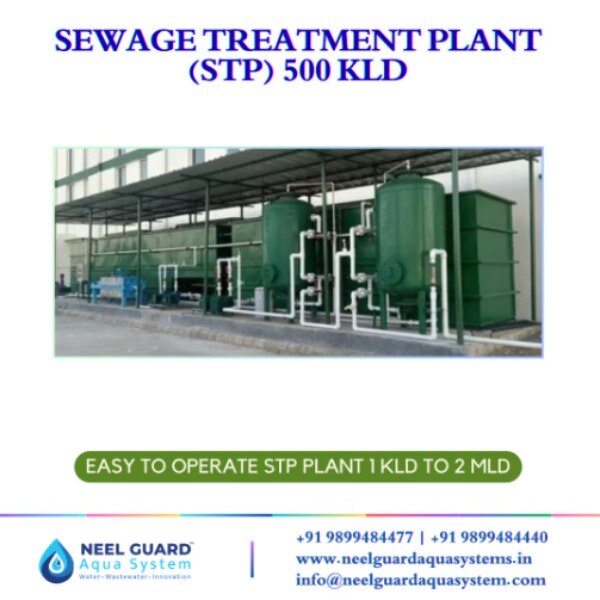
 | SEWAGE TREATMENT PLANT (STP) SEWAGE TREATMENT PLANT 500 KLD ₹7500000 A 500 KLD (Kilo Liters per Day) Sewage Treatment Plant is a large-capacity, industrial-grade system designed to treat huge volumes of sewage water... View product → |
Frequently asked questions
How do you determine whether a 500 KLD sewage treatment plant fits a development?
Compare the projected daily sewage flow with 500,000 litres per day, using water demand, occupancy, commercial loads and infiltration assumptions rather than apartment count alone.
Why must average sewage flow be separated from peak hydraulics?
A plant can match the average daily volume yet fail during morning or evening peaks. Check peak daily flow, peak hourly flow, inlet pumping capacity and equalisation volume.
When should a development use parallel treatment trains?
Use parallel trains when the site needs maintenance continuity, staged loading, easier troubleshooting or partial operation during equipment failure.
What should the STP specification include besides treatment capacity?
Specify treated-water reuse targets, process technology, equalisation, standby pumps and blowers, bypass controls, access for maintenance, sludge handling and commissioning tests.