
Smaller and growing industrial facilities often face a practical wastewater challenge. Their effluent volume may be too significant for basic collection arrangements, while a very large treatment plant would be unnecessary for current production.
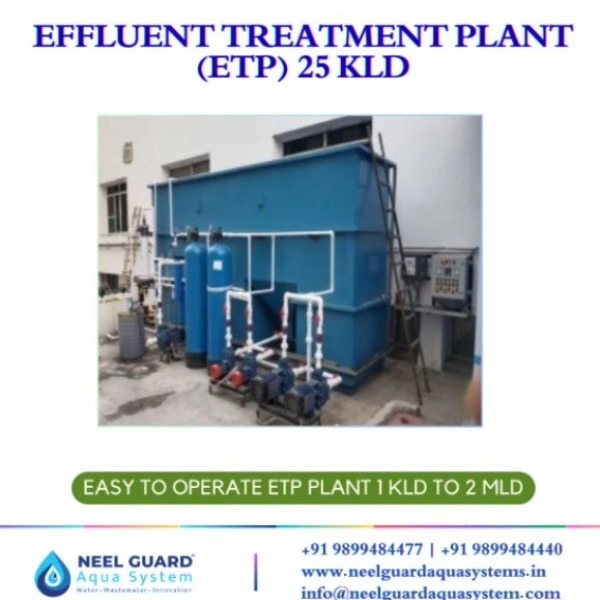
An Effluent Treatment Plant 25 KLD can address this requirement when wastewater generation and treatment calculations indicate a capacity of approximately 25 kilolitres per day.
For industrial operators in Delhi, understanding what a 25 KLD ETP actually includes makes equipment selection easier.
What Happens Inside an ETP
Wastewater treatment normally occurs in stages rather than through a single machine.
The first stage may remove larger suspended materials. An equalisation tank can then collect and balance wastewater before subsequent treatment.
Depending on wastewater composition, treatment can involve:
- pH correction
- Coagulation
- Flocculation
- Settling
- Biological treatment
- Clarification
- Filtration
- Sludge handling
- Final polishing
The exact arrangement must correspond with the wastewater being treated.
Neel Guard Aqua System provides industrial water and wastewater treatment systems with capacities selected according to application requirements.
Who May Need a 25 KLD System
This capacity can be relevant to small and medium industrial facilities where daily wastewater generation is within the appropriate range.
Possible applications include manufacturing units, processing facilities, workshops, institutional operations, commercial facilities, and specialised production environments.
The suitability of 25 KLD capacity should still be verified using actual flow information.
Why Equalisation Matters
Industrial wastewater rarely arrives at a perfectly constant rate.
Production cycles, equipment washing, cleaning operations, batch processes, and shift timings can create sudden changes in flow. An equalisation stage helps reduce these variations before wastewater moves into subsequent treatment processes.
It can also help manage fluctuations in wastewater characteristics.
Questions to Ask During ETP Planning
Before selecting a system, industrial buyers should establish:
- How much wastewater is generated daily?
- What are the peak discharge periods?
- Which contaminants are present?
- What treated-water quality is required?
- Will any treated water be reused?
- How much installation space is available?
- How will generated sludge be managed?
- Is production expected to increase?
Clear answers allow suppliers and project teams to recommend a more appropriate treatment configuration.
A Practical Approach for Delhi Industries
Industrial sites across Delhi can differ substantially in layout, water consumption, production activity, and wastewater characteristics. Site-specific assessment is therefore preferable to selecting an ETP from capacity alone.
A properly configured Effluent Treatment Plant 25 KLD in Delhi should balance treatment requirements, operating practicality, available space, and future needs. Industries planning a new wastewater treatment installation can approach Neel Guard Aqua System for system evaluation based on their actual wastewater and operational requirements.