A 100 KLD rating is useful only when it matches the sewage your project will actually generate, including pollutant load, hourly peaks and future growth. You will be able to calculate a defensible design flow, test the plant’s process and utility requirements, and decide whether 50 KLD, 100 KLD, 200 KLD or a modular arrangement is the safer choice.
Key takeaways
- Base capacity on sewage flow, occupancy and return-to-sewer losses.
- Test average flow against peak demand and future expansion plans.
- Match treatment technology to wastewater strength and discharge limits.
- Compare footprint, utilities, operations and lifecycle cost before buying.
Calculate sewage flow from people, water use and return-to-sewer losses
A 100 KLD STP capacity calculation starts with sewage flow, not the building’s water-supply connection. Estimate each user group’s daily water use in litres per person per day, multiply by the connected population and occupancy factor, then apply the return-to-sewer fraction.
Add flows that bypass domestic consumption, such as kitchen discharge, and allow for infiltration where groundwater can enter drains.
For a residential screening check, 100 KLD divided by 100 litres per person per day indicates about 1,000 fully occupied residents; at 135 litres, it indicates about 740. These figures exclude return-to-sewer losses, staff, visitors and infiltration, so do not use them as a final design basis.
For example, calculate an apartment project as follows:
- 900 residents × 0.85 occupancy factor × 135 litres × 0.80 return = 82.6 KLD
- Staff and visitors: 100 people × 50 litres × 0.80 return = 4 KLD
- Documented infiltration allowance = 8 KLD
The estimated average is 94.6 KLD, close to a nominal 100 KLD plant. That capacity equals only 4.17 m³/h on average; verify equalization and inlet pumping before approval. Recheck the total using full occupancy and planned expansion, not only today’s connected population.
Test average flow against peaks, low-load periods and future expansion
A 100 KLD plant treats 100 m³/day on average, or about 4.17 m³/h, not 4.17 m³ every hour. A project can meet its average daily sewage flow yet overload the inlet during short residential or industrial surges.
Check the plant’s design peak flow, inlet pumping arrangement and equalization tank volume; undersized hydraulics can send a surge through treatment before the biological process responds.
Equalization smooths timing, not total capacity. If the tank is too small, peak flow reaches downstream treatment units; if it is oversized without mixing or aeration, low-load periods can create septic sewage, odour and settled solids.
Include days when occupancy is low, because biological systems receiving little wastewater can lose stable loading and produce inconsistent effluent.
Test pollutant load as well as volume. One hundred cubic metres at 300 mg/L BOD equals 30 kg BOD/day; at 600 mg/L, it equals 60 kg/day. Confirm aeration and process capacity against the higher credible load.
Model full occupancy and documented growth, then reserve expansion capacity or plan a second train instead of treating today’s average as a permanent limit.
Match the treatment process and effluent quality to the wastewater
A 100 KLD plant is genuinely usable only when its process can handle both the wastewater’s flow and pollutant load, while producing water that meets the receiving system’s standard. The nameplate means 100 m³/day, or an average 4.17 m³/h; it does not eliminate hourly peaks or equalization needs.
1. Characterise the influent before choosing equipment. At 100 m³/day and 300 mg/L BOD, the plant receives 30 kg BOD/day; at 600 mg/L, it receives 60 kg/day. Oils, solvents, biocides, heavy metals, high salinity, extreme pH and cleaning chemicals can inhibit biology, so industrial sources may need segregation and pretreatment.
2. Define the treated-water destination in writing. Sewer discharge, surface-water discharge, toilet flushing, landscaping, cooling-tower makeup and process reuse impose different limits for BOD, TSS, nutrients, filtration, disinfection, monitoring and outage protection. A plant sized for sewer discharge is not automatically suitable for reuse.
3. Match the process to that duty. Conventional activated sludge can suit stable domestic sewage where footprint is available. MBBR adds protected media for compact biological treatment; SBR handles batch cycles and variable occupancy; MBR produces low-solids effluent for demanding reuse but adds membrane fouling control, energy use and operating skill.
Choose two 50 KLD trains instead of one 100 KLD train when maintenance continuity and low-flow operation matter more than simplicity.
Check the footprint, utilities, operating work and lifecycle cost
A 100 KLD plant fits only when the site can provide its physical footprint, utilities, operating attention and whole-life budget—not merely 100 m³ of daily sewage capacity.
1. Confirm the STP footprint from a general-arrangement drawing, including tanks, blowers, control panels, sludge handling, chemical storage, access paths and maintenance clearance. Two 50 KLD trains improve maintenance resilience and low-flow operation, but add equipment, controls, footprint and complexity.
2. Check utilities against the supplier’s schedule. Record the electrical connected load in kW and required supply phase, then allow for pumps, blowers, mixers, filtration and disinfection. Locate the plant away from occupied rooms, because blower noise and vibration need acoustic treatment and a maintenance route.
3. Specify odour control before civil work starts. Covered inlet and equalization tanks, vent pipes, activated-carbon filters or biological scrubbers need space and replacement access; otherwise odours can reach homes, kitchens or public areas.
4. Assign operating work by task: daily inspection, sludge wasting, screen cleaning, chemical replenishment, laboratory sampling and alarm response. Budget an operator, electricity, chemicals, testing, sludge transport, membrane or filter replacement and unplanned repairs over the plant’s service life.
5. Compare capital cost with five-year operating cost, not the equipment quote alone. Ask for itemised power consumption, spare parts, consumables, warranty exclusions and annual maintenance charges before choosing 100 KLD.
Set approval, testing and commissioning requirements before purchase
A 100 KLD nameplate proves only the advertised hydraulic rating. Before ordering, make the contract identify the discharge or reuse destination, design flow profile, influent loads, process limits and numerical treated-water quality targets.
Obtain these documents before approval:
- Consent to establish, proposed consent to operate conditions, and the State Pollution Control Board limits that apply to the site.
- A signed design basis showing average and peak flow, BOD, COD, TSS, pH, oil and grease, nitrogen, salinity and other relevant contaminants.
- Process-flow diagrams, equipment schedules, P&IDs, sludge and reject-water arrangements, chemical consumption, power demand and maintenance requirements.
- A performance guarantee stating each parameter, sampling method, test duration, permitted operating range and remedy for failure.
| Destination | Specify in the contract | Acceptance evidence |
|---|---|---|
| Sewer or surface water | Consent limits and discharge monitoring points | Composite and grab samples at agreed flows |
| Toilet flushing or landscaping | BOD, TSS, turbidity, E. coli and residual chlorine targets | Independent laboratory results and disinfection records |
| Cooling or process reuse | Conductivity, hardness, silica, nutrients and microbial limits | Trial operation under representative reuse demand |
Commission the plant through hydraulic, electrical, alarm, sludge-handling and continuous-load tests. Release final payment only after an agreed performance trial demonstrates treated-water quality at design flow, with calibrated instruments and signed laboratory reports.
Compare 50 KLD, 100 KLD and 200 KLD before making the capacity decision
A single 100 KLD STP fits when measured or defensible forecast sewage is near 100 m³/day, peak flow is controlled by equalization, the organic load suits the process, and the discharge or reuse standard is fixed. Its nominal average is only about 4.17 m³/h; it will not absorb every hourly surge without storage.
| Option | What it means | When it applies |
|---|---|---|
| 50 KLD STP | Smaller train with lower initial capacity | Choose for current flow well below 100 m³/day, or as one train in a two-train arrangement |
| 100 KLD STP | One train rated for 100 m³/day | Choose when flow, BOD/COD loading, peak hydraulics and future demand all fit the design basis |
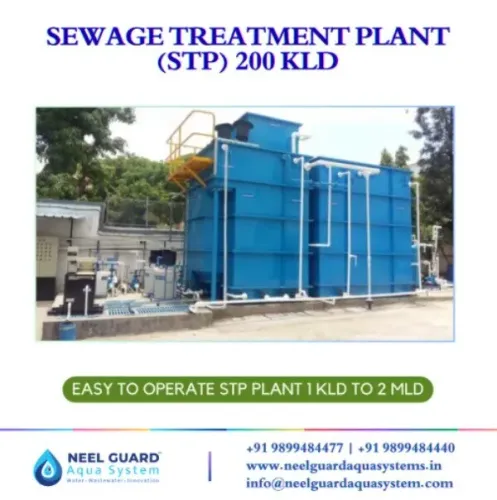
| 200 KLD STP | Larger single train or two 100 KLD trains | Choose when forecast flow approaches 200 m³/day, expansion is imminent, or one outage would have serious consequences |
Two 50 KLD trains provide partial operation during maintenance and better low-flow turndown, but add pumps, controls, footprint and operator checks. Staged expansion suits uncertain growth: install one train and reserve space, piping and power for another.
Ask NEEL GUARD AQUA SYSTEMS to compare these layouts using occupancy, maintenance access and outage consequences, not nameplate capacity alone. Industrial streams still need compatibility testing; 100 KLD of solvent- or metal-laden wastewater is not ordinary domestic sewage.
Related product
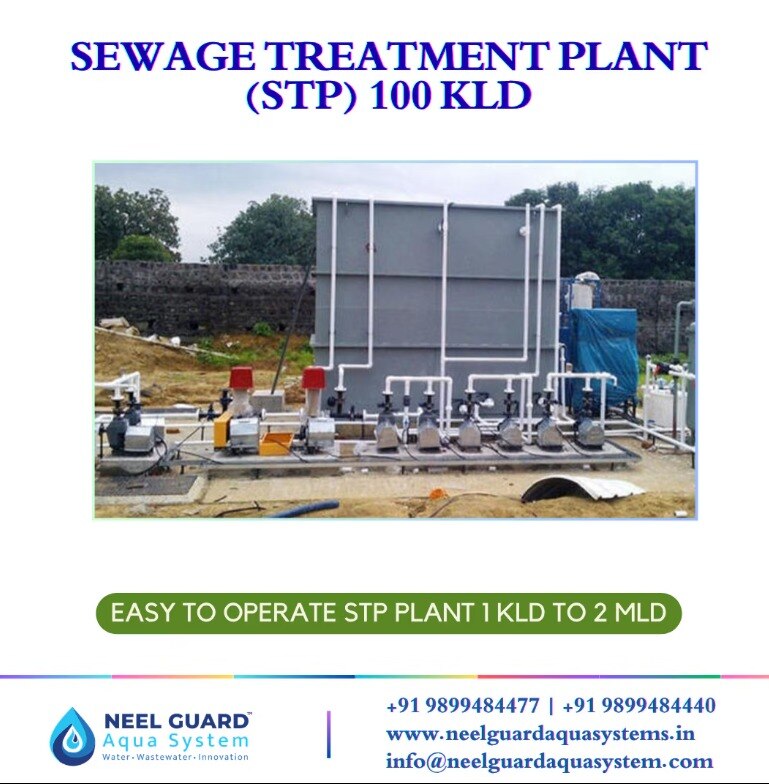
 | SEWAGE TREATMENT PLANT (STP) SEWAGE TREATMENT PLANT 100 KLD ₹4200000 A 100 KLD (Kilo Liters per Day) Sewage Treatment Plant is a heavy-duty system designed to treat large volumes of sewage water from big residential... View product → |
Frequently asked questions
How do you calculate the required sewage treatment plant capacity?
Multiply each user group’s daily water use by connected population and occupancy, then apply the return-to-sewer fraction. Check the result against peak flow and expansion plans.
Is average sewage flow enough to select a 100 KLD STP?
No. Compare average flow with peak inflow, low-load periods and future occupancy. A plant sized only for average flow can struggle during peak discharge or biological underloading.
How should you choose the treatment process for a 100 KLD STP?
Choose the process after checking wastewater characteristics and required effluent quality. Domestic sewage and industrial wastewater may need different treatment stages and operating controls.
What should you compare before choosing a 50, 100 or 200 KLD plant?
Compare hydraulic capacity, peak handling, footprint, power and utility needs, operator workload, maintenance requirements and lifecycle cost.
What requirements should be set before purchasing an STP?
Define approval documents, influent and treated-effluent testing, performance criteria, commissioning steps and handover records in the purchase specification.