A 20 KLD rating describes a daily average, not the largest flow your site can send in one hour. Before approving equipment, you need to verify the sewage quantity and quality, separate incompatible streams, match the process to the intended reuse or discharge, and confirm that the site can operate the plant safely.
Key takeaways
- Treat 20 KLD as 20 m³ per day, not peak hourly flow.
- Base capacity on measured demand and peak-flow patterns.
- Test sewage quality before selecting the treatment process.
- Require performance guarantees, commissioning tests and operator training.
Is 20 KLD the right capacity for your site?
A 20 KLD STP capacity calculation starts with measured site demand, not the building’s nameplate population. Treat 20 KLD as 20 m³ per day, or about 0.83 m³ per hour on average; it is not the maximum instantaneous flow.
Build the estimate in this order:
1. Record occupancy by shift, operating hours, seasonal occupancy and weekend shutdowns. Note water supplied, kitchen or other non-domestic water use, and the sewage flow per person per day. People multiplied by sewage generated per person per day gives a first estimate, but water supplied is not the same as wastewater generated.
2. Separate domestic sewage from RO reject, cooling-tower blowdown and other streams. Add infiltration only when it is measured or conservatively assessed; stormwater and groundwater can dilute biological loading while increasing hydraulic flow.
3. Obtain an hourly inflow profile. Mark morning and evening peaks, batch discharges, wet-weather peaks and low-flow periods, then calculate the peak factor. Check whether screens, pumps, biological reactors and clarifiers can accept the peak sewage flow.
4. Ask for the equalisation tank working volume, not merely its total volume. Confirm how it manages low flow and sudden surges, and check the hydraulic retention time at every treatment stage.
The design basis must show minimum flow, average flow and peak hourly flow. A plant can treat its 20,000-litre daily average yet overflow or wash out during a short peak.
What must be tested and kept out of the sewage line?
A biological STP works only when its feed is domestic sewage. Keep these streams out of the collection network unless the design includes segregation, pretreatment and a separate consent basis:
- Roof drainage, stormwater and groundwater infiltration
- Cooling-tower blowdown and RO reject
- Workshop wastewater, solvents and chemical waste
- Septic-tank sludge and high-salinity wastewater
Kitchen wastewater needs a grease trap or grease interceptor. Investigate laundry chemicals, disinfectants and cleaning agents because toxic or saline discharges can suppress the microorganisms that remove organic pollution.
Before ordering equipment, commission STP influent testing on representative samples for pH, BOD, COD, TSS, oil and grease, ammonia, total nitrogen, phosphorus, chloride, conductivity and temperature. Add pathogen testing when treated water will be reused or the discharge consent requires it. BOD COD TSS testing from one quiet day is not enough.
Sample under these conditions:
| Sample period | What it reveals | Why it matters |
|---|---|---|
| Normal operation | Routine pollutant and flow levels | Establishes the design baseline |
| High-load or peak-use period | Stronger sewage and hydraulic surges | Tests biological and equalisation requirements |
| Wet weather | stormwater infiltration sewage; diluted pollutants with higher flow | Prevents hydraulic overload and misleading process data |
Ask the project consultant and the State Pollution Control Board or Pollution Control Committee to confirm Consent to Establish STP India requirements and Consent to Operate conditions. Check the approved discharge point, sampling arrangement, treated-water limits, reuse conditions and sludge-disposal route before finalising the plant.
Which treatment process and outlet specification fit the job?
Choose the process only after mapping the full STP treatment stages: screening, grit removal, equalisation, biological treatment, secondary settling or membrane separation, disinfection, treated-water storage, sludge handling and odour control. Compare minimum-flow performance, peak-flow tolerance, footprint, power demand, sludge production and operator skill; a compact reactor is not a complete design.
| Option | What it requires | Main trade-off |
|---|---|---|
| MBBR | Retained carriers, reliable aeration and secure carrier retention | Tolerates load variation, but lost carriers reduce treatment capacity |
| SBR | Timed fill, react, settle and decant cycles, with dependable level instruments and sequencing | Flexible footprint, but controls and timing failures disrupt settling |
| Activated sludge sewage treatment | Disciplined sludge-age control, return-sludge control and wasting | Familiar process, but operator workload and sludge production are higher |
| MBR | Membranes, backwash, cleaning chemicals and fouling control | Produces high-quality separated water, but adds replacement-cost exposure |
| Other attached-growth systems | Match media, aeration and loading to the selected system | Footprint, process tolerance and operator workload vary |
Define the outlet before accepting a supplier figure: sewer discharge, surface-water discharge, toilet flushing, gardening, cooling or another reuse. Obtain State Pollution Control Board or Pollution Control Committee Consent to Establish and Consent to Operate conditions, including limits for BOD, COD, TSS, ammonia or total nitrogen, phosphorus, faecal coliform and residual chlorine.
Reuse also needs treated water reuse standards, a separate labelled reclaimed-water network, backflow protection, storage and disinfection. NEEL GUARD AQUA SYSTEMS is useful when it converts these site data into a documented process and equipment comparison instead of sizing from capacity alone.
Related product
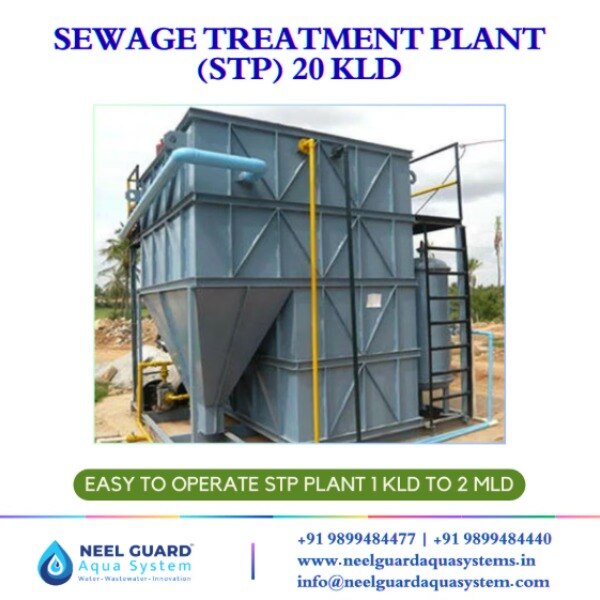
 | SEWAGE TREATMENT PLANT (STP) ₹1200000 A 20 KLD (Kilo Liters per Day) Sewage Treatment Plant is a robust and efficient wastewater treatment system designed for medium to large residential... View product → |
Can the site physically support the plant and keep it running?
A 20 KLD plant is physically viable only when the STP hydraulic profile matches the site elevations. Before selecting pumps, document the inlet invert, tank operating levels, overflow and discharge levels, pipe losses, minimum submergence, freeboard, flood level, and the elevation of reuse storage or the final discharge point.
A higher outlet can turn apparent gravity flow into permanent pumping.
Check the STP civil foundation requirements for soil bearing capacity, settlement, groundwater uplift, empty-tank buoyancy, seismic design, vehicle loads and corrosion protection. Leave a clear route for removing pumps, blowers and membranes; a packaged unit becomes unserviceable if equipment cannot be lifted out.
Specify duty standby pumps sewage plant logic, duty/standby blowers, automatic restart after power restoration, high-level alarms, phase-failure protection and overload protection. A suitable STP backup power arrangement must run aeration, recirculation, pumping and controls, not just lighting.
| Power provision | What it must support | Failure risk |
|---|---|---|
| Utility only | Normal operation | Treatment stops during outages |
| Generator | Aeration, recirculation, pumping and controls | Undersizing causes biological and hydraulic failure |
| Generator plus emergency storage | Continuous treatment or contained flow during faults and maintenance | Requires tested capacity and alarm response |
Provide emergency storage and containment for power failure, pump failure, high inflow and planned maintenance. Do not rely on an untreated-sewage bypass where consent conditions prohibit it.
Review odour, aerosol, noise and worker safety: provide cleaning access at screens and sludge areas, confined-space controls for hydrogen sulfide and oxygen deficiency in wet wells or enclosed tanks, and place blowers and air-relief equipment away from occupied areas.
What must the contract and commissioning plan guarantee?
A 20 KLD label does not guarantee treated-water quality. Your STP performance guarantee must use an agreed influent envelope and test method covering flow, BOD, COD, TSS, pH, temperature, oil and grease, ammonia or total nitrogen, salinity and site-specific toxicants.
1. Specify independent influent and final-effluent STP sampling points with safe access, required flow measurement, sample preservation provisions and a written schedule for grab and composite samples. State the laboratory and reporting method.
2. Define sludge management in sewage treatment before commissioning: expected sludge production, wasting frequency, holding capacity, dewatering method, polymer or other consumables, covered storage and an authorised disposal or co-processing route.
3. Attach an STP commissioning checklist covering seeding, acclimatisation, ramp-up, minimum and maximum test loads, laboratory selection, operator training, spare parts and consumables. Acceptance must require a stated number of consecutive compliant samples, not one day of testing.
4. Record the remedy for missed performance, including corrective work, retesting and responsibility for extra operating costs. Biological treatment needs stabilisation after startup.
5. Require operating manuals, alarm-response procedures, preventive-maintenance schedules and daily checks for pumps, blowers, dissolved oxygen, sludge wasting and disinfection. The contract should also state how failed instruments, unavailable samples and abnormal influent loads affect acceptance.
Frequently asked questions
Is 20 KLD the right capacity for my site?
Confirm demand from measured water use, occupancy and discharge patterns. A 20 KLD plant handles 20 m³ per day, averaging about 0.83 m³ per hour; it does not define peak instantaneous flow.
What should be tested before sewage enters the plant?
Test the incoming sewage and identify contaminants, grease, chemicals, stormwater and solids that could disrupt biological treatment. Keep industrial chemicals, oils, rainwater and non-degradable waste out of the sewage line.
How do I choose the treatment process and outlet specification?
Match the process to sewage characteristics, available space, reuse plans and the required treated-water quality. Write outlet limits, sampling methods and permitted uses into the project specification.
What site conditions must be checked before installation?
Verify space, access for delivery and maintenance, foundation strength, drainage, power supply, ventilation, odour control and safe operator access before ordering equipment.
What should the contract and commissioning plan guarantee?
Specify treatment capacity, outlet-quality limits, testing procedures, trial-run duration, documentation, operator training, warranty response and remedies if the plant fails its acceptance test.