A 2,000 LPH rating describes permeate production under defined design conditions, not guaranteed output in every shift or season. You need to match that output to peak demand, confirm the required water and temperature specifications, and calculate the chiller, storage, pretreatment, and reject-water requirements before selecting the system.
Key takeaways
- Treat 2,000 LPH as permeate output, then size storage around production peaks.
- Match online chiller capacity to inlet temperature, flow, and required process-water temperature.
- Check conductivity, hardness, silica, and microbiological limits against the process specification.
- Compare recovery, reject-water use, energy, maintenance, and downtime—not output alone.
What 2,000 LPH means for your production schedule and storage tank
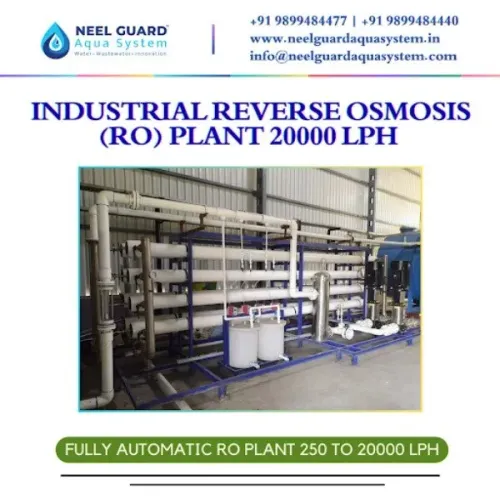
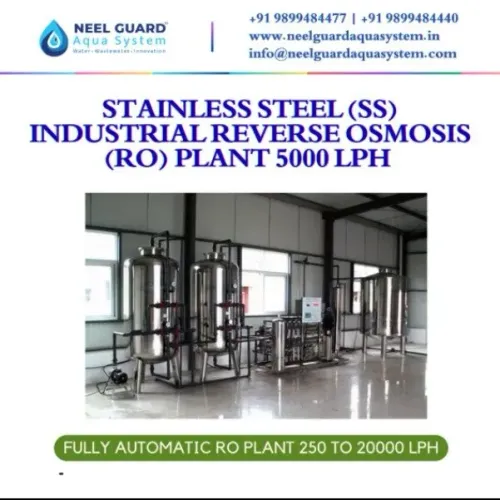
A 2,000 LPH RO plant is rated to produce 2,000 litres of permeate per hour under stated design conditions, not to process 2,000 litres of feed water.
At continuous operation, its nominal RO permeate capacity is 48 m³ per day; during one 8-hour shift, the figure is about 16 m³ before start-up, flushing, downtime, and temperature-related derating.
Temperature matters. Colder feed water is more viscous, so a plant rated at 2,000 LPH at 25 °C can produce less at a lower temperature unless the design includes temperature correction or additional membrane area. Fouling, low pressure, and ageing membranes reduce output as well.
Use this procedure for storage tank sizing:
- Calculate your peak process demand in litres per hour and total demand for each shift.
- Confirm the supplier’s guaranteed permeate flow at your actual feed temperature, pressure, recovery, and membrane condition.
- Compare production with demand during every hour; a tank must cover the shortfall, not the plant’s nameplate capacity.
- Add working volume for RO stoppages, pretreatment backwash or regeneration, maintenance isolation, and the chiller’s pull-down time.
- Keep operating reserve separate from unusable tank volume below the outlet and high-level cut-off.
At 75% recovery, producing 2,000 LPH requires about 2,667 LPH of feed and creates roughly 667 LPH of reject. The final tank size therefore depends on demand timing and interruptions, not simply on the “2,000 LPH” label.
How the online chiller controls temperature without compromising RO performance
The chiller belongs downstream of the membranes, not on the RO feed line. A Kirloskar 2 TR chiller removes heat from permeate through a heat exchanger, while a temperature controller adjusts chilled-water flow or compressor operation to hold the selected outlet temperature.
Keeping the RO near its design temperature avoids the viscosity penalty that cold feed water creates; chilling the feed can reduce permeate flow at the same pressure.
- Confirm the required inlet temperature, outlet setpoint, permeate flow, and plant-room ambient temperature. The stated 2 TR cooling capacity equals about 7 kW of heat removal, but the available capacity depends on those actual conditions.
- Check the rating at the required leaving-water temperature, not only the nameplate test point. At 2,000 LPH, every 1°C reduction removes roughly 2.3 kW before tank, pipe, heat-exchanger, and ambient gains, so the chiller may need a recirculation loop rather than single-pass cooling.
- Trend permeate temperature, flow, conductivity, feed and concentrate pressure, differential pressure, and tank levels. Temperature-normalize flow and conductivity before diagnosing fouling or membrane failure.
- Insulate the chilled process water loop, eliminate stagnant branches, provide drainability, and define a sanitation routine. Cooling does not disinfect permeate; biofilm can still grow in a poorly turned-over tank.
Temperature control earns its cost when formulation, rinsing, or another heat-sensitive step needs both low ionic load and repeatable water temperature. If the process only needs low conductivity, the chiller adds electrical demand, heat rejection, maintenance, and a failure point without improving RO water quality.
Which process-water system configuration fits your demand and risk profile?
Choose the configuration by matching peak flow, temperature sensitivity, and tolerance for downtime—not by comparing RO flow ratings alone. This chilled RO system comparison separates four different risks:
| Option | Best fit | Main trade-off |
|---|---|---|
| Chilled 2,000 LPH RO package | Steady demand needing temperature-controlled permeate near the RO output | Compact, but still needs buffer volume for chiller pull-down, maintenance, and interruptions |
| RO plant without chiller | Processes that accept ambient-temperature water | Lowest complexity; adding temperature control later requires space and integration work |
| RO plant plus standalone water chiller | Existing RO plant with occasional or independently controlled cooling demand | Flexible, but extra pumps, controls, heat gain, and hygiene points need management |
| Larger RO plant with chilled-water buffer tank | Peak demand exceeds 2,000 LPH or production cannot stop during RO service | Higher capital and storage volume; stagnant tank zones become a quality risk |
A 2,000 LPH chilled package suits continuous or predictable consumption. Select the larger plant and chilled-water buffer tank when simultaneous users, cleaning cycles, or shift peaks exceed production capacity. Choose an RO plant without chiller when temperature has no process specification.
Do not size the chiller from flow alone. Cooling 2,000 LPH by 5°C requires about 11.6 kW before pump heat, pipe losses, ambient heat, and inefficiency; verify capacity at the actual outlet temperature and plant-room conditions.
NEEL GUARD AQUA SYSTEMS should provide the chiller duty, tank turnover, sanitation method, and peak-demand assumptions for comparison. Cooling does not disinfect water: hygienic, drainable pipework and controlled recirculation remain necessary.
Related product
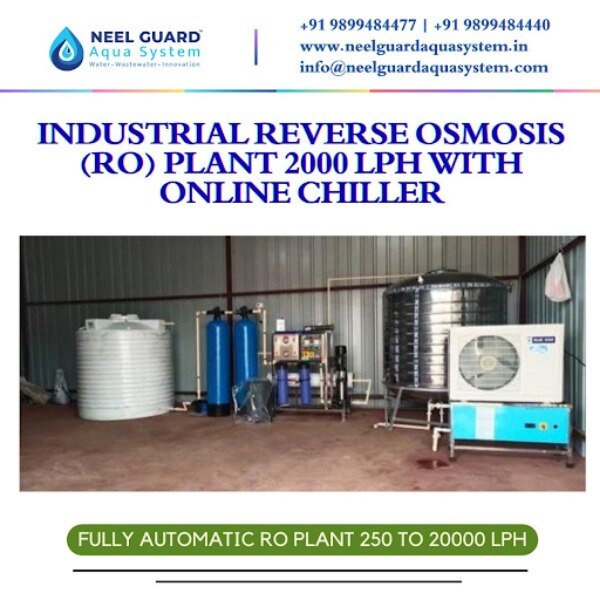
 | REVERSE OSMOSIS (RO) PLANTS INDUSTRIAL RO PLANT 2000 LPH WITH ONLINE CHILLER ₹285000 Neel Guard Aqua Systems proudly presents a 2000 LPH Industrial Reverse Osmosis (RO) Plant integrated with a Kirloskar Online Chiller (2 TR),... View product → |
Why RO water quality and process-water suitability require separate checks
A low permeate conductivity does not prove that water is suitable for your process. RO permeate quality describes dissolved-ion removal; process suitability also depends on temperature, microbiological control, silica, hardness, and the materials or product that contact the water.
Confirm the following before selecting the plant:
1. Test the feed water for pH, turbidity, conductivity and TDS, hardness, alkalinity, silica, iron, manganese, suspended solids, and free chlorine. Use these results to specify RO pretreatment, such as multimedia filtration, a softener or antiscalant dosing, cartridge filtration, and an activated carbon filter for chlorine removal.
2. Verify that the pretreatment protects polyamide membranes. Measure free chlorine after the activated carbon filter, because oxidant breakthrough can damage membranes quickly. Set cartridge-filter replacement by differential pressure, not by calendar date alone.
3. Write the product-water specification in numbers. Confirm the permitted conductivity and TDS, silica, hardness, chloride, and microbial count for your process; a formulation, final rinse, boiler feed, and cooling application will not share the same limits.
4. Specify temperature at the point of use, not only at the RO outlet. Include the acceptable range, maximum temperature, storage time, tank material, and whether ultraviolet treatment, recirculation, or sanitisation is required.
5. Trend permeate conductivity, flow, feed and concentrate pressure, differential pressure, temperature, and tank levels. Temperature-normalize flow and conductivity before judging membrane performance, or cold water can look like fouling or membrane failure.
How recovery, reject water, and operating data determine the system’s true value
A 2,000 LPH rating describes permeate output under stated design conditions, not raw-water demand. At 75% RO recovery rate, producing 2,000 LPH requires about 2,667 LPH of feed and creates roughly 667 LPH of RO reject water; actual recovery depends on feed chemistry, scaling risk, and membrane limits.
Obtain these figures before sizing utilities and maintenance:
1. Record the design permeate flow, feed flow, recovery, operating hours, feed temperature, feed pressure, concentrate pressure, and expected daily volume. Use them to calculate raw-water demand and tank capacity rather than multiplying the nameplate rating by shift hours.
2. Identify the reject flow and its disposal route. Multiply hourly reject by operating hours, then confirm whether the drain, evaporation system, or reuse circuit can accept that volume and its dissolved-solids load.
3. Establish a commissioning baseline for permeate flow, conductivity, pressure drop, temperature, and salt passage. Log permeate flow monitoring continuously, with feed and product-tank levels where storage affects delivery.
4. Compare later readings using temperature-normalized RO performance. Cold water is more viscous and produces less permeate, so uncorrected flow data can falsely suggest fouling; define maintenance triggers with the membrane supplier using site data.
5. Record the chiller’s inlet temperature, outlet setpoint, flow, heat load, and recovery-loop arrangement. A chiller stabilizes delivery temperature, but it does not increase RO capacity; chilling the permeate downstream avoids reducing output through cold-feed operation.
Frequently asked questions
What does a 2,000 LPH RO plant produce?
It produces up to 2,000 litres of permeate per hour under its stated design conditions. Feed-water demand is higher because part of the feed leaves as reject water.
Why add an online chiller to an industrial RO plant?
An online chiller controls process-water temperature after or within the treatment arrangement, helping maintain the temperature required by production without treating warmer water as if it were cooler.
How should you choose a process-water system configuration?
Compare continuous demand, peak demand, available storage, required uptime, maintenance access, standby equipment, feed-water variability, and the cost of production interruptions.
Is RO water automatically suitable for every process?
No. Compare permeate conductivity, hardness, silica, pH, temperature, and microbiological requirements with the process specification before approving the water.
Which operating figures reveal an RO plant’s true value?
Track permeate flow, recovery percentage, reject-water volume, feed and permeate conductivity, pressure, temperature, energy use, chemical consumption, membrane cleaning, and downtime.