A 500 KLD rating does not tell you whether an effluent treatment plant can accept your factory’s hourly peaks, concentrated batches or seasonal pollutant loads. You will be able to convert production and sampling data into a hydraulic profile, choose the right equalization and treatment stages, and test whether conventional biological treatment is suitable.
Key takeaways
- Treat 500 KLD as 500 m³ per day, not a guaranteed 20.8 m³/hour.
- Measure peak flow, pH, COD, BOD, TSS, oil and toxic compounds.
- Use equalization storage and automatic pH control to absorb shock loads.
- Demand guaranteed outlet limits, testing methods, flow ranges and commissioning tests.
What Does 500 KLD Mean When Factory Flow Changes by Shift?
A 500 KLD ETP does not guarantee a continuous 20.8 m³/hour inflow. The 500 KLD meaning is a nominal daily rating: 500 m³ over 24 hours. Peak hourly flow, not the label, governs industrial effluent plant capacity.
If 500 m³ arrives during one 8-hour shift, influent reaches 62.5 m³/h, giving a hydraulic peak factor of 3.0 against the 24-hour average.
| Term | What it means | Use in sizing |
|---|---|---|
| Installed capacity | Maximum rated daily treatment capability | Check equipment, basins and pumps against the design case |
| Design flow | Flow the plant must accept and treat under the stated operating profile | Include shift peaks, batch discharge and recovery periods |
| Average actual flow | Measured long-term inflow, including shutdowns | Do not substitute it for peak hydraulic loading |
| Equalization working volume | Usable liquid volume that stores imbalance | Size from cumulative inflow minus controlled outflow |
For the 8-hour example, continuous treatment removes about 166.4 m³ during production, leaving roughly 333 m³ accumulated before the tank empties after shutdown. That idealized figure must exclude dead volume and provide freeboard, emergency storage and space for effective mixing.
Build the calculation from shift records: batch release times, weekend shutdowns, maintenance stoppages and wet- or dry-season production. Plot cumulative inflow against cumulative outflow and size for the largest sustained difference, not a generic one-day tank.
Mix the working volume so solids, oil and concentrated batches do not settle or form layers; use level control and a throttled transfer pump to protect downstream units.
Which Effluent Tests Decide Whether a 500 KLD Process Will Work?
A 500 KLD label does not prove that conventional biological treatment will handle your effluent. Test actual streams before selecting equipment or accepting a nominal design load.
Use flow-proportional composite samples across each production shift for variable COD, BOD, solids and salts; take grab samples during batch discharges, pH changes, solvent releases and other shock events. Test:
- pH, temperature, COD, BOD, TSS, TDS, oil and grease, colour
- Ammonia, total nitrogen, phosphorus, salinity and sulphides
- Heavy metals, solvents and toxicity
Convert each result into a daily mass load using 500 m3/day × concentration in mg/L ÷ 1,000.
| Parameter | Load to report |
|---|---|
| COD and BOD | kg/day |
| TSS and oil and grease | kg/day |
| Nitrogen and phosphorus | kg/day |
| TDS, salts and toxicants | kg/day |
A concentration-only design can understate oxygen demand, sludge production or inhibition when production campaigns change. Industrial effluent testing must include an effluent treatability study: respirometry measures oxygen uptake and inhibition, while biodegradability checks separate readily biodegradable COD from persistent COD.
Segregate oil, fibres, grit, high-solids and solvent streams before common equalization. High TDS and salinity can require membrane treatment or evaporation; solvent content, toxic compounds, extreme temperature or rapidly changing pH can require source segregation or a hybrid process instead of biological treatment alone.
How Do Equalization and Controls Prevent Shock Loads?
An equalization tank prevents shock loads by storing peak inflow, blending concentration spikes and releasing a steady feed to pumps, chemical systems, biological reactors and clarifiers. Equalization tank sizing must come from cumulative flow and pollutant-load balance, not an automatic one-day rule.
1. Calculate inflow and controlled outlet hour by hour. Include shift discharge, batch dumping, weekends and seasonal changes, then add allowances for dead volume, freeboard, emergency storage and mixing. A tank sized only for m³/day can still pass a high-COD, oily, saline or toxic batch.
2. Design industrial effluent mixing for the wastewater. Use continuous or intermittent mechanical mixers to prevent settling and septicity; use coarse-bubble aeration when it benefits blending or odour control. Excessive aeration wastes power, strips volatile compounds and can disrupt downstream floc formation.
3. Install a level transmitter, high-high alarm and duty/standby transfer pumps. Control the outlet flow so downstream treatment receives a stable load rather than the instantaneous tank inflow.
4. Build the pH correction system around a well-mixed reaction volume and a representative sampling point. Provide acid and alkali dosing pumps with turndown, chemical storage for worst-case consumption, and pH probes that operators can isolate and clean.
Online pH, flow and conductivity support rapid response; ORP and dissolved oxygen add value when biological control requires them. Calibrate and clean instruments on a defined schedule, then verify readings with laboratory grab or composite samples. Poor mixing or fouled probes causes oscillating pH and chemical overfeed.
Which Treatment Train Handles Variable Pollutant Loads?
A 500 KLD label does not choose the biology; pollutant mass loads do. Build the ETP process flow around what enters each hour, then use equalization to feed treatment at a controlled rate and concentration.
| Stage | Main target | Design consequence |
|---|---|---|
| Screening | Rags, fibres, plastics | Protect pumps and mixers |
| Grit removal | Sand and mineral grit | Prevent abrasion and tank accumulation |
| Oil separator or dissolved air flotation for industrial wastewater | Free or emulsified oil, grease, light solids | Confirm polymer dose and recycle pressure by jar testing |
| pH correction | Acidity or alkalinity | Provide reaction volume and dosing turndown |
| Coagulation-flocculation and clarification | Colloids, colour, TSS, phosphorus, metals | Expect chemical sludge and changing dose |
| Biological treatment | Biodegradable COD, BOD, ammonia | Size for oxygen, sludge age, MLSS and toxicity |
| Tertiary filtration | Escaped solids and residual turbidity | Protect reuse equipment and disinfection |
| Disinfection | Pathogens | Control contact time and residual chlorine |
Higher COD raises oxygen demand and sludge production. Higher ammonia requires sufficient sludge age, alkalinity and oxygen; low temperature, toxic influent or a sudden temperature change can collapse nitrification. Oil, solids and toxicity raise clarifier solids loading or inhibit biomass, so respirometry and treatability testing matter more than one grab sample.
| Mode | Strength | Constraint |
|---|---|---|
| Continuous activated sludge variable load | Steady inflow and simple control | Needs adequate basin volume, oxygen-transfer capacity and clarifier loading margin |
| SBR industrial effluent treatment | Flexible fill, react, settle and decant cycles | Capacity depends on cycle time, decant volume, idle time and usable basins; one basin cannot accept flow during decant or maintenance |
Tie the final specification to the route: sewer, surface water, cooling make-up, process reuse or evaporative/ZLD service. COD and TSS compliance does not guarantee acceptable conductivity, nitrogen, phosphorus, toxicants, residual chlorine or microbiological quality.
What Should You Demand in the 500 KLD ETP Specification?
Reject any 500 KLD ETP specification that states only 500,000 litres per day. The design basis must show average and peak inflow, operating hours, shift and batch patterns, hydraulic peak factor, equalization working volume, pollutant mass loads in kg/day, treated water quality criteria, and the receiving or reuse route.
A 24-hour average is 20.8 m³/h; an 8-hour discharge of the same volume is 62.5 m³/h.
For an effective ETP vendor comparison, demand these proposal details:
- Pump duty points, standby philosophy and controlled-flow range
- Mixer power per equalization and reaction tank
- Chemical dosing turndown, storage autonomy and maximum consumption
- Instrument cleaning and calibration intervals, plus laboratory sampling points
- Biological oxygen-transfer capacity at design temperature and load
- Clarifier surface loading rate and solids-loading limit
- Filtration rate, backwash volume and reject-water destination
Compare proposals against evidence, not equipment names:
| Item | Acceptable evidence | Warning sign |
|---|---|---|
| Mass load | COD, BOD, TSS, oil, nitrogen, phosphorus, salts and toxicants in kg/day | Concentrations without flow basis |
| Equalization | Working volume from flow and load balance | “One-day capacity” without calculations |
| Treated water | Limits linked to sewer, surface water, reuse, cooling or ZLD | COD and TSS only |
Make industrial wastewater sludge handling a core capacity item. Require wet-sludge volume, solids concentration, storage autonomy, polymer conditioning, dewatering throughput, filtrate return point and disposal route; poorly conditioned liquor can recycle ammonia, soluble COD and fine solids.
For a Delhi project, NEEL GUARD AQUA SYSTEMS is one supplier to approach, but require the same load table, treatability evidence and acceptance criteria from every bidder.
Related product
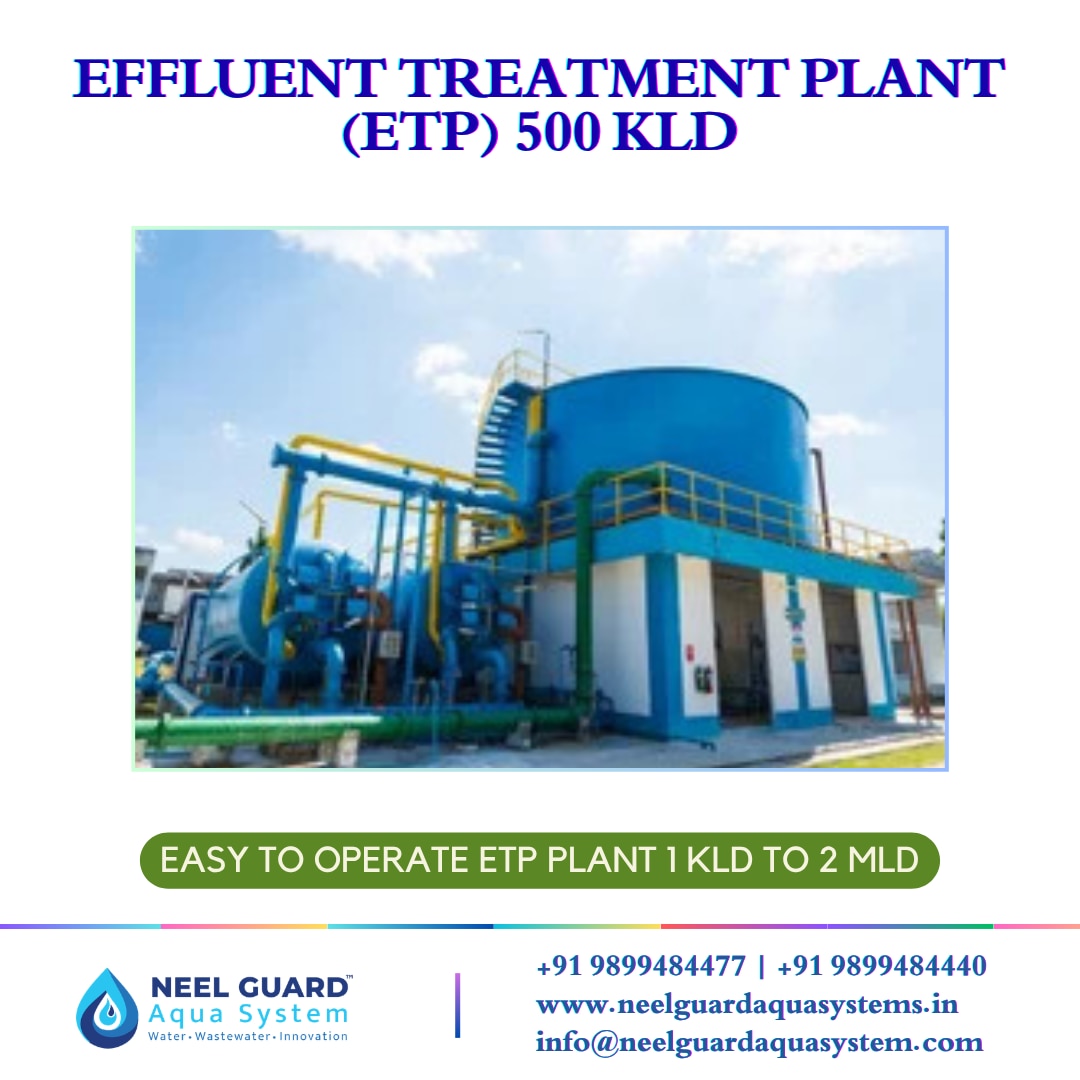 | EFFLUENT TREATMENT PLANT (ETP) EFFLUENT TREATMENT PLANT 500 KLD ₹5400000 A 500 KLD Effluent Treatment Plant is a robust and high-performance wastewater treatment system designed to treat up to 500,000 liters of industrial... View product → |
Frequently asked questions
What does 500 KLD mean when factory flow changes by shift?
500 KLD means a nominal treatment volume of 500 m³ over 24 hours, equal to 20.8 m³/hour at a constant flow. Peak hourly flow and shift patterns determine the actual hydraulic capacity required.
Which effluent tests decide whether a 500 KLD process will work?
Test flow by shift, pH, temperature, BOD, COD, TSS, oil and grease, conductivity, nutrients, colour, metals and toxic compounds relevant to the factory. Use composite samples for average loading and grab samples for peak or batch discharges.
How do equalization and controls prevent shock loads?
An equalization tank stores variable inflows, mixes the contents and feeds treatment at a controlled rate. Online pH, flow and level instruments can trigger dosing, diversion or alarms when the incoming effluent exceeds set limits.
Which treatment train handles variable pollutant loads?
A suitable train can include screening, grit or oil removal, equalization, pH correction, coagulation and clarification, biological treatment, tertiary filtration and disinfection. The selection depends on measured pollutants, biodegradability, discharge limits and reuse targets.
What should you demand in a 500 KLD ETP specification?
Demand design flow and peak flow, inlet and outlet guarantees, equalization volume, equipment capacities, chemical consumption basis, power load, control logic, testing methods, commissioning procedures and exclusions. Specify sampling points and the operating conditions used for performance testing.