A 2 MLD nameplate does not tell you whether the plant will handle your factory’s real wastewater load. You need to translate production patterns into hourly flow, measure pollutant mass rather than relying on averages, and select each treatment stage against a defined discharge or reuse target.
Key takeaways
- Use measured daily, peak, cleaning, and abnormal flows—not shift count alone.
- Separate acidic, alkaline, toxic, oily, and high-strength streams before biological treatment.
- Size tanks and equipment for peak pollutant loads, not average flow alone.
- Specify treated-water limits, test methods, and acceptance periods in the contract.
Confirm the hydraulic design basis before calling the plant 2 MLD
A 2 MLD ETP design capacity is justified only when measured flow and pollutant loads show that 2,000 m³/day covers production, cleaning and abnormal operating conditions without relying on uncontrolled dilution. For wastewater treatment plant sizing, do not multiply a single flow reading by the number of shifts.
1. Run a characterisation campaign across every operating shift, production batch, washdown cycle, weekend and abnormal discharge. Record instantaneous and hourly flow, then calculate average daily flow, maximum daily flow and peak hourly flow.
2. Sample each distinct stream and test pH, temperature, BOD, COD, TSS, oil and grease, TDS or conductivity, chloride, sulphate, ammonia, nitrogen, phosphorus, colour, sulfide, heavy metals, solvents and industry-specific toxic compounds. Match every result to its time, batch and production quantity.
3. Convert the records into an hourly mass balance. At 2 MLD, 5,000 mg/L COD equals 10,000 kg COD/day, while 2,000 mg/L BOD equals 4,000 kg BOD/day; that load can demand far more biological and sludge capacity than a municipal plant at the same flow.
4. Separate equalization volume from emergency storage. Equalization smooths predictable hourly or batch variation; emergency storage contains spills, power failures or treatment outages and must not be counted as routine throughput.
5. Calculate primary solids, biological waste sludge and chemical precipitates, including moisture, polymer demand, storage time, dewatering capacity and disposal route. A plant can meet its hydraulic target yet stop when sludge storage or cake handling fills.
6. Verify tank elevations, freeboard, pump capacity and overflow paths at maximum water level, blocked-screen, failed-pump and power-loss conditions. Averages do not prove that 2 MLD is safe.
Measure pollutant loads and isolate incompatible wastewater streams
Do not size protection from average COD alone. An industrial wastewater characterisation campaign must cover every operating shift, production batch, cleaning cycle, weekend, and abnormal discharge. Time-stamp flow readings and match them to laboratory results; one grab sample can miss a batch release that overwhelms biological treatment.
Collect and test:
- Flow, pH, temperature, TSS, TDS or conductivity, oil and grease
- BOD, COD, nitrogen, phosphorus, sulfide, chloride, sulfate, colour, heavy metals, solvents
- Industry-specific toxicants, inhibitory compounds, and any chemical used in production or cleaning
Use flow-proportional composite sampling for routine organic-load trends, but take separate grab samples during tank emptying, chemical dosing, washdown, or a suspected spill. Composite results can hide a short toxic spike.
Calculate COD and BOD loading as concentration multiplied by daily flow: at 2 MLD, 5,000 mg/L COD equals 10,000 kg COD/day, while 2,000 mg/L BOD equals 4,000 kg/day.
Route concentrated acid or alkali, solvent-bearing wastewater, metal rinses, high-salinity brine, and disinfectant streams to labelled holding tanks instead of sending them directly to biology. Install online pH and conductivity monitors, high-high alarms, sampling points, and isolation valves before equalization.
Divert suspect inflows to contained storage under a written release procedure; never use dilution as the treatment method. Confirm nutrient additions through measured biomass demand and inhibition testing, not an assumed BOD:N:P ratio.
Choose the treatment train from contaminants and the final water-use target
Choose the ETP treatment train from the contaminant profile and final water-use target, not from 2 MLD alone. Define limits for COD, BOD, TSS, pH, nutrients, oil and grease, salinity, metals, pathogens, colour and toxic compounds before selecting equipment.
A plant that meets BOD and TSS limits can still fail reuse because conductivity, residual chemicals or microbes remain too high.
| Process | Select it when | What goes wrong if omitted |
|---|---|---|
| Screening and grit removal | Solids, fibres, plastics or grit enter the influent | Pumps, valves and downstream tanks clog or wear |
| Oil removal; coagulation flocculation and DAF | Fats, oils, grease or high suspended solids require separation | Biological treatment loses capacity and sludge becomes difficult to dewater |
| Equalization and pH neutralization | Batch flows, corrosive discharges or inhibitory pH swings occur | A concentrated slug shocks biology or damages equipment |
| Chemical precipitation | Metals, phosphorus or selected dissolved contaminants exceed limits | Toxicity or nutrient discharge remains above target |
| Anaerobic/aerobic biological treatment | Biodegradable COD or BOD dominates; high COD may justify anaerobic pretreatment before aerobic polishing | Organics pass through, while an anaerobic stage alone may leave poor final quality |
| Tertiary polishing, activated carbon or membrane treatment | Reuse requires low colour, trace organics, pathogens, TDS or conductivity | The effluent fails its actual reuse specification |
| Evaporation or another process | Salinity, zero-liquid-discharge or non-biodegradable waste defeats conventional treatment | Concentrate disposal becomes the unresolved problem |
Run treatability tests for biodegradability, toxicity, sulfide, alkalinity, temperature and methane potential before anaerobic selection. Include primary solids, biological sludge and chemical precipitates in the sludge balance, with polymer demand, storage, dewatering and disposal capacity. A hydraulically adequate plant can still stop when sludge handling is undersized.
Size equalization, biological treatment, aeration, clarifiers, and sludge handling for peak loads
At 2 MLD, 5,000 mg/L COD equals 10,000 kg COD/day; 2,000 mg/L BOD equals 4,000 kg BOD/day. Calculate the equalization tank volume from hourly inflow minus the controlled discharge rate, using the largest cumulative imbalance, then add mixing volume, dead storage and freeboard. Size emergency storage for the specified outage, pump failure or blocked-screen duration.
- Set biological volume from peak biodegradable mass, target food-to-microorganism ratio, solids retention time and the required effluent limit. Do not use daily average flow alone.
- Calculate aeration oxygen demand from carbon oxidation, nitrification and endogenous respiration. Correct blower capacity for wastewater alpha-factor, temperature, altitude, diffuser fouling, minimum dissolved oxygen and turndown.
- Check primary, flotation and secondary clarifiers at peak flow and peak solids. Hydraulic surface loading and solids loading must both remain within the selected design limits; otherwise blanket rise and solids carryover will remove biological inventory.
- Calculate sludge from primary solids, waste biological solids and chemical precipitates. Convert wet tonnes to storage volume using moisture content, then match polymer demand, sludge dewatering throughput, cake storage and disposal frequency.
Draw a maximum-water-level profile before fixing tank elevations. Verify gravity flow, pump-well capacity, freeboard, overflow paths, backflow prevention and final discharge level during peak flow, power loss and failed pumps. Equalization mixing, controlled aeration or another odour-control measure provides shock load protection; an idle, septic tank can release a concentrated slug.
Turn the design into a performance-based procurement and acceptance specification
Make payment and acceptance depend on an ETP performance guarantee, not on installed equipment. The contract must define the influent flow, pollutant loads, temperature range, operating hours and permitted variability that the supplier must treat, then test the plant under those conditions.
- Require a commissioning performance test lasting enough to cover stable operation and representative production cycles, with samples from influent, each critical process stage and final discharge or reuse outlet.
- Specify sampling frequency, preservation, chain of custody, laboratory accreditation and analytical methods for COD, BOD, TSS, pH, oil and grease, nutrients, metals, salinity, pathogens and industry-specific toxicants.
- Tie acceptance to the named effluent discharge and reuse standards, including limits for pH, conductivity, colour and residual chemicals—not only BOD and TSS.
- Require online pH conductivity monitoring, high-high alarms, diversion to equalization and a documented response to toxic or nonconforming inflow.
- Demand reports for blower energy, chemical consumption, sludge quantity and moisture, polymer demand, dewatering capacity, odour and noise where specified.
- State the remedy for failure: corrective work and a repeat test at the supplier’s cost, with retention, liquidated damages or rejection if guaranteed limits remain unmet.
NEEL GUARD AQUA SYSTEMS should receive the same measurable schedule: guaranteed values, sampling points, test conditions, reporting templates and sign-off rules. Equipment inspection can confirm installation; only load-based testing proves treatment performance.
Related product
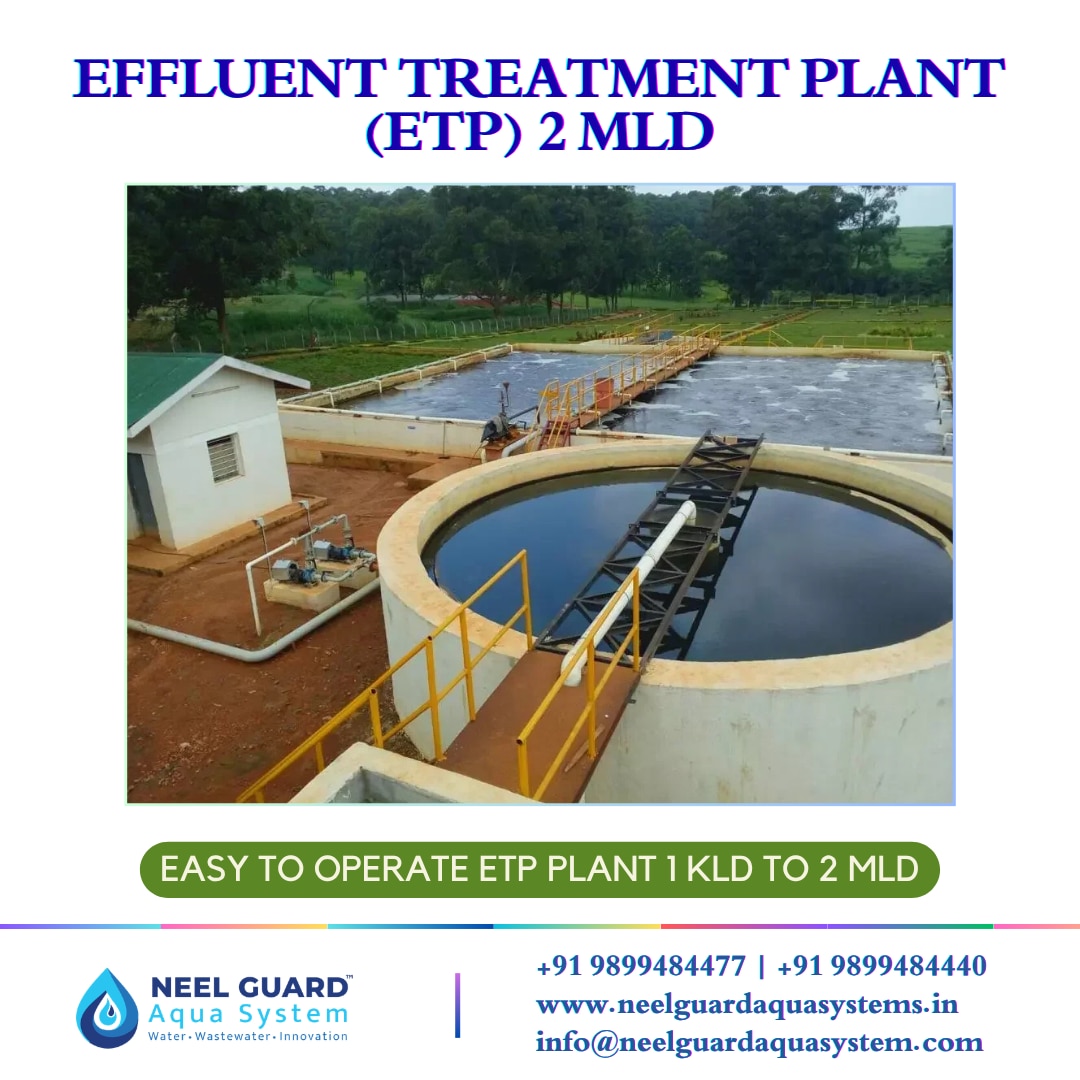 | EFFLUENT TREATMENT PLANT (ETP) EFFLUENT TREATMENT PLANT 2 MLD ₹15000000 A 2 MLD (Million Liters per Day) Effluent Treatment Plant is a high-capacity wastewater treatment system designed to treat and purify industrial... View product → |
Frequently asked questions
What hydraulic data confirms a plant is truly 2 MLD?
Use measured production, cleaning, peak-hour, shutdown, and abnormal flows to verify that 2,000 m³/day covers the design basis without uncontrolled dilution.
Why should wastewater streams be separated before treatment?
Separate acidic, alkaline, toxic, oily, and high-strength streams when their chemistry could inhibit biology, overload equalization, or require different pretreatment.
How do you choose an ETP treatment train?
Match unit processes to measured contaminants and the final water-use target, including physical, chemical, biological, tertiary, and disinfection stages where required.
What belongs in an ETP procurement and acceptance specification?
Define flow and load guarantees, treated-water limits, sampling locations, test methods, operating conditions, sludge requirements, and the acceptance period.