A 5,000 LPH label does not tell you how much water the plant will deliver during a production shift, how much feed it will consume, or whether the membranes will remain protected. By matching hourly demand with storage, recovery, feed-water analysis, pretreatment, operating data and concentrate handling, you can judge whether the capacity will produce dependable process water.
Key takeaways
- Calculate daily and peak demand before selecting 5,000 LPH.
- Add flushing, start-up, cleaning and maintenance water to your balance.
- Test feed water before choosing pretreatment and membrane protection.
- Require output, recovery and water-quality checks in commissioning documents.
Is 5,000 LPH enough for your actual process-water demand?
A 5000 LPH RO plant sizing decision starts with process water demand, not the nameplate flow. Calculate daily requirement as hourly consumption × operating hours, then add allowance for membrane flushing, start-up, cleaning, cartridge changes and maintenance. Compare that volume and the peak water demand with usable RO storage tank capacity.
| Scenario | Demand pattern | Sizing implication |
|---|---|---|
| 30 m³ in an 8-hour shift | 3.75 m³/h average, with possible simultaneous peaks | A 5 m³/h permeate plant produces 40 m³ in eight hours before downtime; storage must cover peak draw and interruptions. |
| 5 m³/h continuously | 120 m³ over 24 hours in theory | The plant has no recovery window for flushing, cleaning or repairs, so a larger plant or buffer tank protects supply. |
| 10-hour profile with peak users | Demand extends beyond the eight-hour production window | Storage or a larger plant is required when hourly draw exceeds available production. |
At 75% recovery, a 5 m³/h permeate plant needs about 6.67 m³/h of feed and produces 1.67 m³/h of concentrate. Size storage by usable volume, not gross volume: subtract dead volume, low-level pump protection and operating reserve.
Select expansion capacity for planned production increases; a unit running continuously at its limit loses resilience as membranes foul, age or feed temperature falls.
What do the 5,000 LPH rating, recovery and water balance actually mean?
A 5000 LPH permeate rating means 5,000 litres of product water per hour under stated feed temperature, TDS or conductivity, pressure, recovery and permeate-quality conditions. It does not mean 5,000 LPH of feed water.
At 75% recovery, the RO recovery calculation is 5 m³/h ÷ 0.75 = approximately 6.67 m³/h feed. The balance leaves approximately 1.67 m³/h concentrate, so specify both feed flow and reject flow for disposal or reuse.
The theoretical 24-hour production is 5 m³/h × 24 = 120 m³. Actual output falls with cold feed water, fouling, membrane age, flushing, cleaning, cartridge changes and planned stoppages.
Increasing recovery reduces concentrate volume but raises concentrate salinity and scaling risk. A higher recovery setting is not free capacity; it demands suitable pretreatment, antiscalant control and a membrane projection that confirms the design limit.
Require these figures in the quotation:
- Feed pressure and concentrate pressure
- Design temperature and allowable pressure drop
- Membrane flux and salt rejection
- Recovery percentage
- Separate feed, permeate and concentrate flows
- Permeate conductivity or other guaranteed quality limit
Brackish-water pressure assumptions in the roughly 10–25 bar range do not apply automatically to seawater service. Seawater has a different pressure class, and high salinity, low temperature, fouling or high recovery can also require pressure outside a basic brackish-water estimate.
Which feed-water test and pretreatment train should protect the membranes?
Finalise the RO pretreatment design only after a complete RO feed-water analysis; a single TDS number cannot size membranes or predict scaling. Request the sampling location, collection date, laboratory method, and raw-water operating range. Include SDI: below 5 is a commonly used RO-feed target, but SDI does not reveal every scaling or organic-fouling risk.
Record:
- TDS or conductivity, pH, temperature, turbidity, total hardness, alkalinity, and silica.
- Iron, manganese, chloride, sulphate, oil and grease, and TOC or COD.
- Microbiological counts, including the laboratory’s units and detection limits.
| Finding | Protection | Control |
|---|---|---|
| Suspended solids and turbidity | Multimedia filter | Verify turbidity and SDI after pretreatment |
| Oxidants and organics | Activated carbon | Check carbon performance and organic breakthrough |
| Free chlorine | Dechlorination with carbon, sodium metabisulfite, or a validated combination | Run a DPD chlorine test at the membrane inlet and monitor residual; assumed dosing is not enough |
| Iron or manganese above the membrane projection | Dedicated iron or manganese removal | Confirm removal before the RO stage |
| Hardness or scaling potential | Softening or antiscalant dosing | Base the choice on hardness, alkalinity, silica, sulphate, recovery, and the membrane projection |
| Fine particles | Cartridge filtration | Install it before the high-pressure pump and monitor differential pressure |
Free chlorine breakthrough can irreversibly damage thin-film composite polyamide membranes. Test at the inlet before exposure, because a downstream reading cannot undo membrane damage.
How will you prove consistent output after commissioning?
Prove consistency with a documented baseline, not the nameplate flow. Use RO performance monitoring to separate low production caused by fouling from hydraulic imbalance or poor feed conditions.
1. Before acceptance, record the actual feed analysis and require a membrane projection. It must justify element count, membrane area, vessel arrangement, flux, per-vessel recovery, concentrate flow and pressure drop. Capture baseline feed conductivity, feed temperature, permeate flow, concentrate flow, feed pressure, concentrate pressure and permeate pressure.
2. Define sampling points: membrane-inlet feed after pretreatment, concentrate at the array outlet, and permeate at the common product header. Perform temperature-compensated permeate conductivity testing and trend normalized permeate flow, salt passage and pressure drop against the commissioning baseline.
Configure alarms for low feed pressure, high feed or concentrate pressure, high cartridge-filter differential pressure, low permeate flow, high permeate conductivity, abnormal concentrate flow and oxidant breakthrough.
3. Investigate and clean when performance reaches the membrane maker’s trigger: a 10% loss of normalized permeate flow, a 10% increase in normalized salt passage, or a 15% increase in normalized pressure drop. Apply the maker’s calculation and cleaning procedure rather than a calendar schedule alone.
Include microbiological acceptance testing because RO permeate is not sterilized water. Sample feed, permeate, storage tank and distribution-line outlets at defined temperatures, membrane age and test methods; add UV, ozone or post-chlorination where tank or loop control requires it.
What should the quotation and installation specification include?
A comparable quotation must define what the 5,000 LPH claim measures: permeate flow, not feed flow, and under which feed temperature, TDS or conductivity, pressure, recovery and water-quality limits.
Use this RO plant quotation checklist:
- Guaranteed permeate flow, recovery, permeate conductivity or salt-rejection limit, operating pressure range, membrane model, element count and membrane projection.
- Pretreatment equipment, chemical dosing points, cartridge-filter rating, instruments, alarms, control logic, flushing sequence and access for membrane, pump and filter maintenance.
- Concentrate flow and its disposal or reuse route. At 75% recovery, allow for approximately 1.67 m³/h of continuous concentrate from a 5 m³/h permeate plant.
- Feed and discharge limits for pH, salinity, temperature, oxidants and every cleaning chemical, including the proposed cleaning procedure.
The 316L RO skid specification should separate materials by wetted component:
| Component | Specify | Verify |
|---|---|---|
| Wetted piping and fittings | 304 or 316L grade, weld finish, passivation and chloride limit | Material certificates and weld inspection |
| Pressure vessels | Vessel material, pressure rating and corrosion allowance | Nameplate and test records |
| Pumps and wetted parts | Casing, shaft and impeller materials | Datasheet against feed chemistry |
| Gaskets and seals | Material compatible with feed and cleaning chemicals | Manufacturer compatibility statement |
Stainless steel is not automatically hygienic: crevices, rough welds, stagnant zones and poor drainability retain chemicals and accelerate chloride corrosion. Require sloped drainable lines and documented passivation.
Evaluate NEEL GUARD AQUA SYSTEMS by these design inputs, factory checks and commissioning records, not by capacity or polished skid photographs alone.
Related product
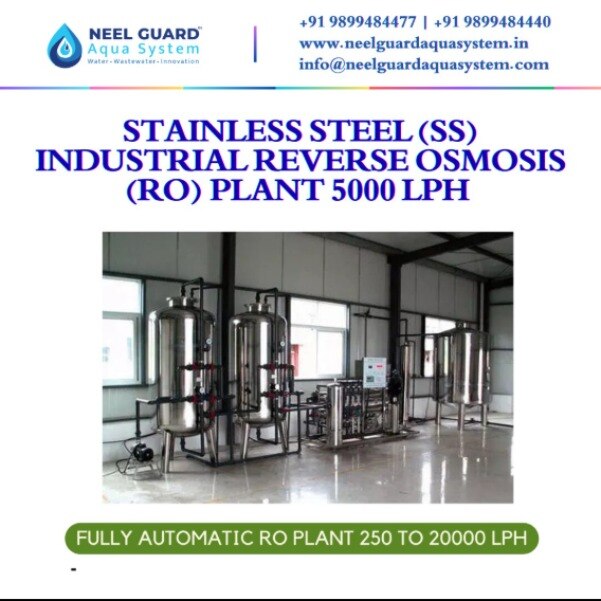
 | REVERSE OSMOSIS (RO) PLANTS STAINLESS STEEL INDUSTRIAL RO PLANT 5000 LPH ₹890000 The SS Industrial RO Plant (5000 LPH) is engineered to treat high-TDS, brackish, and borewell water efficiently. View product → |
Frequently asked questions
Is a 5,000 LPH RO plant enough for process-water demand?
Compare hourly and daily process consumption with the plant’s operating hours, peak demand and usable RO storage capacity. Add water needed for flushing, start-up, cleaning, cartridge changes and maintenance.
What does a 5,000 LPH RO rating mean?
The rating identifies the stated permeate production flow under defined feed-water and operating conditions. Confirm the conditions, recovery percentage, reject flow and actual water balance in the specification.
Which feed-water tests are needed before selecting pretreatment?
Test the source for pH, TDS, hardness, alkalinity, turbidity, iron, manganese, silica, chlorine and microbiological contamination. Use the results to select pretreatment and membrane protection.
How do you prove consistent RO output after commissioning?
Record permeate flow, feed and reject flow, recovery, pressure, conductivity and key water-quality results during commissioning. Repeat readings under comparable operating conditions to establish a baseline.
What should an industrial RO plant quotation include?
Request the design flow, feed-water assumptions, recovery, reject flow, membrane and vessel details, pretreatment equipment, tanks, instruments, materials, installation scope, testing procedure and commissioning documents.