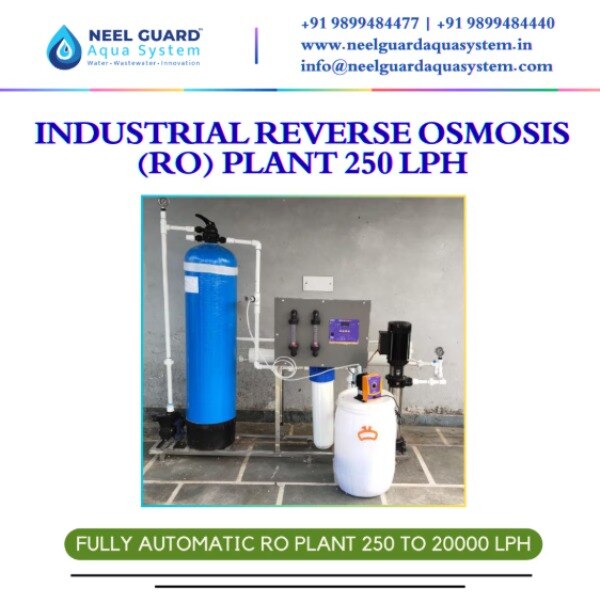
A 250 LPH plant does not automatically supply 250 litres at every outlet or meet every daily demand. You will be able to convert the rated permeate flow into usable production, match it to peak consumption and storage, identify the required pretreatment, and compare RO with lower-cost alternatives before specifying equipment.
Key takeaways
- Treat 250 LPH as rated permeate flow, not guaranteed hourly delivery.
- Size production from daily demand, peak use, recovery and planned downtime.
- Test feed water before selecting pretreatment, membranes and dosing equipment.
- Specify reject disposal, automatic safeguards and storage for dependable operation.
What 250 LPH delivers during an actual operating day
A 250 LPH permeate flow is a rated product-water capacity, not a promise that every outlet receives 250 litres each hour. It describes permeate production under stated reference conditions; lower feed temperature, higher TDS, fouling, pressure variation and scheduled downtime reduce actual daily water output.
| Operating time | Theoretical permeate output |
|---|---|
| 8 uninterrupted hours | 2,000 litres |
| 10 uninterrupted hours | 2,500 litres |
| 16 uninterrupted hours | 4,000 litres |
Treat these figures as an upper planning limit. Startup, flushing, cleaning and interruptions reduce the volume available for use, so measure the operating schedule rather than multiplying 250 by 24. A treated-water storage tank separates steady RO production from uneven demand and prevents short peaks from exhausting the supply.
Write down each use in litres and the time it occurs. A requirement for 250 litres during a 30-minute peak is a 500 LPH demand at that moment; a 250 LPH plant needs usable tank volume prepared beforehand, or a larger plant.
Size the tank for the peak, reserve and recovery time, not just the day’s total.
Check reject handling before selecting the unit. At 60% recovery, producing 250 LPH permeate consumes about 417 LPH feed and creates 167 LPH reject—roughly 1,333 litres during an eight-hour run. The drain, reuse system or storage arrangement must handle that flow.
How to calculate plant size from demand, peaks and storage
Use a water-demand worksheet that totals each use by event and by hour. Record people, batch volume, shift requirement, wash cycle, laboratory work, cooling make-up and production-run demand; do not estimate from average daily consumption alone.
1. Enter the quantity and timing for every use. For example, record 20 people × 5 litres, three 80-litre batches, one 150-litre wash cycle and 25 litres for laboratory work. Add the figures for daily demand and mark the busiest 30-minute and one-hour periods.
2. Confirm that “250 LPH” means 250 litres per hour of permeate, not pump or feed flow. An uninterrupted run gives 2,000 litres in 8 hours, 2,500 litres in 10 hours or 4,000 litres in 16 hours. Deduct startup, flushing, cleaning, cartridge changes, cold-water slowdown and downtime before using those totals for commercial water purification.
3. Calculate peak demand as litres required divided by available minutes. If a process needs 250 litres in 30 minutes, it demands 500 LPH; a 250 LPH plant supplies only 125 litres during that interval. You need a larger plant or a tank holding the 125-litre shortfall.
4. Add storage sizing to the worksheet: required tank volume equals peak-use shortfall plus a reserve for interruptions. Check that the tank, not only the RO skid, can supply simultaneous outlets.
5. Verify feed and reject capacity. At 60% recovery, producing 250 LPH permeate needs about 417 LPH feed and creates 167 LPH reject, so drainage or reuse must match the operating schedule.
Which feed-water tests determine the RO treatment train
A single TDS result cannot select an RO treatment train. Take separate, representative samples from borewell, municipal, tanker or surface-water sources and request a recent feed-water analysis before choosing membranes, pretreatment or dosing controls.
| Test | What it reveals | Design consequence |
|---|---|---|
| TDS, conductivity and temperature | Salt load and seasonal flow change | Set membrane area, pressure and temperature correction |
| Hardness, alkalinity and silica | Calcium carbonate, calcium sulfate and silica scaling risk | Select softening, antiscalant and allowable recovery |
| Iron, manganese, turbidity, colour and SDI15 | Fouling and particulate loading | Specify oxidation, multimedia filtration, cartridge filtration or other pretreatment |
| Free chlorine, chloramine and pH | Polyamide-membrane compatibility | Add dechlorination and set chemical controls |
| Total coliforms, E. coli and bacterial count | Microbiological contamination | Provide disinfection and hygienic storage |
| Nitrate, fluoride, boron or other site contaminants | End-use-specific removal requirement | Confirm membrane rejection and add a polishing stage if needed |
Specify turbidity below about 1 NTU and SDI15 below 5 at the membrane inlet. Iron, colloids and suspended solids can raise differential pressure and permanently reduce flux even when TDS is modest. Do not use a generic antiscalant dose: calculate scaling from hardness, alkalinity, silica, pH, temperature, recovery and concentrate chemistry.
A 60% recovery assumption can create scaling or reject-disposal problems without that calculation.
Also define the permeate limit for conductivity or TDS, hardness, silica and microbiology. Drinking or process water may require nitrate, boron, pH correction, remineralisation, UV or final disinfection.
When RO is useful, unnecessary or incomplete for the end use
A 250 LPH rating means 250 litres per hour of permeate, not feed flow. At 60% recovery, that requires about 417 LPH feed and creates 167 LPH reject; at 75%, it requires 333 LPH and creates 83 LPH reject. Choose the process against a measurable outlet target, not the equipment label.
| Option | What it means | When it applies and quality target |
|---|---|---|
| Commercial packaged RO unit | Standardized RO package, usually with fixed pretreatment | Choose for predictable feed and routine drinking or process water; require specified conductivity, TDS, hardness and microbiological limits |
| 250 LPH RO plant | Smaller RO system for steady demand with storage | Use when the permeate target is up to 250 LPH; specify conductivity or TDS, hardness, silica and microbiology limits |
| 500 LPH RO plant | Roughly double nominal permeate capacity | Choose for peaks or shorter operating hours; keep the same outlet-quality limits, not merely higher volume |
| Water softener | Removes hardness but leaves TDS and most dissolved contaminants | Use for scale control; target outlet hardness, such as ≤5 mg/L as CaCO3, when that suits the equipment |
| Activated-carbon filtration | Removes chlorine, taste, odour and some organics | Use for chlorine protection or sensory improvement; verify free chlorine and turbidity targets |
| Ultrafiltration | Removes suspended solids, colloids and bacteria, not dissolved salts | Use when low turbidity and microbiological reduction matter but low TDS does not |
| Purchased treated water | Outsources treatment and delivery | Use for irregular demand; require a batch report matching your conductivity, TDS, hardness and microbiology limits |
RO remains incomplete when the end use needs remineralization, pH correction, UV, ozone or final disinfection. A laboratory or beverage application may also require limits for boron, nitrate or silica; obtain those limits from the process owner before selecting any system.
What to specify for recovery, reject handling and reliable operation
Require 250 LPH as guaranteed permeate flow, not pump or feed flow, at stated feed temperature, TDS, pressure and recovery. At 60% RO recovery, the plant needs about 417 LPH feed and creates 167 LPH reject; at 75%, it needs 333 LPH and creates 83 LPH.
Demand a temperature-corrected membrane projection, not an unqualified nameplate figure.
| Recovery | Feed required | Reject produced |
|---|---|---|
| 60% | 417 LPH | 167 LPH |
| 75% | 333 LPH | 83 LPH |
Treat reject-water disposal as a design item: obtain sewer acceptance, provide an equalization tank, reuse it for flushing or cooling where water quality permits, or specify evaporation or licensed disposal. At 60% recovery, an eight-hour shift generates about 1,333 litres of concentrate.
Confirm the storage tank, automatic shutdowns, low-pressure and high-TDS alarms, cartridge differential-pressure gauge, and permeate flow and conductivity meters.
Require these before purchase:
- Set membrane cleaning evaluation triggers at a 10% normalized permeate-flow loss, 5–10% normalized salt-passage rise, or 10–15% normalized pressure-drop rise.
- Check outlet water against the intended use and verify NSF/ANSI 58 claims; a certified membrane does not certify the complete installed plant.
- Obtain a P&ID, membrane projection, datasheet, electrical load, commissioning test, calibration records, cleaning procedure, chemical SDS, spare-parts list and O&M manual.
- Ask NEEL GUARD AQUA SYSTEMS to state these figures in the quotation, including reject-water disposal responsibility and acceptance-test conditions.
Related product
 | REVERSE OSMOSIS (RO) PLANTS ₹65000 The 250 LPH Industrial Reverse Osmosis (RO) Plant from Neel Guard Aqua Systems is a compact, efficient, and reliable water purification solution... View product → |
Frequently asked questions
How much water does a 250 LPH RO plant produce in one operating day?
It produces 250 litres per operating hour under stated reference conditions. Daily output falls with colder feed water, high TDS, fouling, pressure changes and downtime, so calculate using actual operating hours and derating factors.
How do you calculate the required RO plant size?
Add daily water demand, identify the highest-use periods, account for storage and divide the required permeate volume by planned operating hours. Include downtime for cleaning, maintenance and regeneration where applicable.
Which feed-water tests are needed before selecting an RO treatment train?
Test TDS or conductivity, pH, temperature, hardness, alkalinity, turbidity, iron, manganese, silica, chlorine and microbiological quality. These results determine pretreatment, antiscalant or softening needs, membrane selection and disinfection.
When is RO useful or unnecessary for commercial water purification?
RO is useful when dissolved salts, hardness or specific contaminants must be reduced. It is incomplete when the end use also requires disinfection, remineralisation or polishing, and unnecessary when the source already meets the required water specification.
What should you specify for a reliable 250 LPH RO plant?
Specify permeate flow at feed temperature and TDS, recovery percentage, reject flow, operating pressure, membrane type, pretreatment, storage volume, cleaning access, alarms, automatic shutdowns and the approved reject-disposal method.