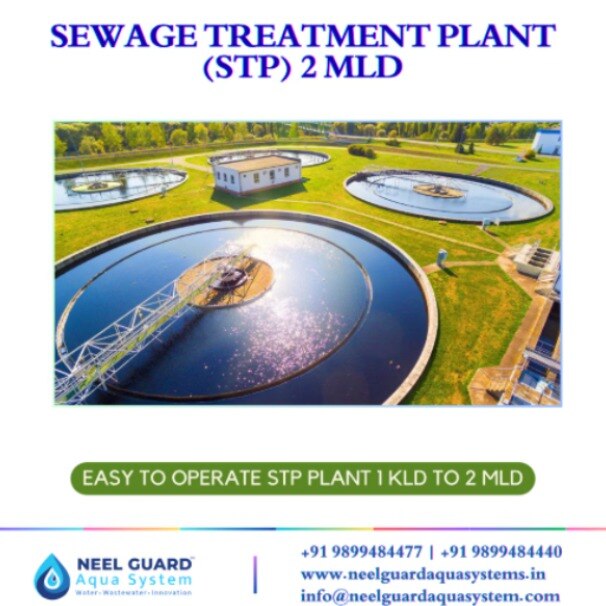
A 2 MLD plant must be sized from measured flow patterns, pollutant loads, reuse targets and expansion needs—not from average daily sewage volume alone. By the end, you will have a design-basis checklist for selecting the process, defining equipment redundancy, verifying Indian compliance and comparing supplier proposals.
Key takeaways
- Confirm peak flow before specifying a 2 MLD plant.
- Use site-specific influent data to calculate organic and solids loading.
- Choose treatment processes based on effluent limits, footprint, and operator capability.
- Specify sludge handling, whole-life cost, and acceptance tests before procurement.
Confirm the Design Flow Before Calling the Plant 2 MLD
Call a plant 2 MLD only when the projected flow profile—not the average alone—supports a 2 MLD design capacity. That capacity equals 2,000 m³/day, or an average of 83.3 m³/h (23.1 L/s), but inlet works, pumps, equalization, and disinfection must also handle short-duration peaks.
- Calculate dry-weather sewage flow from connected population, occupancy, water consumption, commercial use, and confirmed industrial contributions. Apply realistic return-to-sewer assumptions rather than treating all supplied water as sewage.
- Measure minimum night flow and peak hourly flow across representative weekdays, weekends, and seasons. Derive the peak factor from these observations; do not import a generic multiplier without checking local data.
- Separate wet-weather infiltration and inflow from normal sewage. Inspect manholes, storm connections, groundwater entry, and rising-main leakage, then add verified future development and occupancy changes.
- Record tanker, septage, or hauled-waste arrivals separately. A daily volume that fits 2,000 m³/day can still overload screens, pumps, or biological treatment within a few hours.
- Compare hydraulic flow with organic and ammonia loading. Equal average flow does not mean equal treatment demand: concentrated sewage can require more aeration and sludge capacity without increasing the plant’s hydraulic rating.
- Test the projected peak against inlet channels, screens, pumps, equalization, reactor feed, clarifiers, and disinfection contact volume. If any unit fails at peak hourly flow, 2 MLD is not the correct practical capacity.
Equalization deserves a calculation, not an automatic line item. It can reduce peaks, but it adds tank volume, mixing energy, odour control, and a full-tank bypass risk. Size it only after measured variability and the operating strategy are documented.
Build an Influent and Loading Profile That Matches the Site
A domestic sewage process will work only if the influent profile reflects the site’s flow, pollutant loads and harmful substances—not a single average sample. Collect separate dry-weather and wet-weather data, including minimum night flow, seasonal variation and infiltration, because rain dilution can hide loading while sudden peaks overload tanks.
| Site data | What to measure | Design consequence |
|---|---|---|
| Flow pattern | 24-hour flows, peak hourly flow, minimum night flow and wet-weather inflow | Sets hydraulic capacity, equalisation volume and peak-load protection |
| Organic load | Composite BOD5, COD and the BOD5:COD ratio | Shows biodegradable carbon available for biological treatment; a low ratio can restrict conventional biology |
| Solids and nutrients | TSS, ammonia nitrogen, total nitrogen, total phosphorus and alkalinity | Determines aeration, anoxic volume, chemical or biological nutrient removal and alkalinity demand |
| Sewage chemistry | pH, temperature, conductivity or salinity, fats and oils | Identifies conditions that inhibit microbes, reduce oxygen transfer or block equipment |
| Industrial risk | Metals, solvents, disinfectants, hydrocarbons and toxicity indicators from connected businesses | A toxic slug can kill biomass even when domestic samples look acceptable |
| Sidestreams | Centrate or filtrate from sludge dewatering, including ammonia and phosphorus | Prevents hidden recycle loads from increasing peak nitrogen demand |
Take flow-proportional composite samples across weekday, weekend and wet-weather conditions, then calculate kilograms per day for each pollutant. Confirm future occupancy, commercial discharge and prohibited industrial connections before freezing the biological design; identical flow rates can require very different reactor volumes when ammonia or organic loading changes.
Choose the Treatment Train by Effluent Risk, Footprint and Operation
Choose the process against the effluent risk and site constraints, not tank volume alone. BOD and TSS removal may justify a simpler train; ammonia, nitrogen, phosphorus, reuse quality and tight discharge limits demand more stages, controls and sludge handling.
| Option | Footprint and effluent | Operating trade-off |
|---|---|---|
| Conventional activated sludge | Largest footprint because it needs aeration tanks and secondary clarifiers; reliable secondary effluent | Familiar operation, but requires sludge-return control and clarifier performance |
| MBBR | Smaller aeration volume, with attached growth on retained carriers | Check protected surface area, organic and ammonia loading, fill fraction, oxygen transfer and carrier-screen access; blocked screens cause headloss and media loss |
| SBR | Compact batch tanks that combine reaction and clarification | Flexible for nutrient removal, but needs dependable level instruments, valves, sequencing and equalization for continuous inflow |
| MBR | Smallest footprint and consistently low-solids effluent through membranes | Budget for fine screening, fouling control, air-scouring energy, chemical cleaning and membrane replacement |
Select MBBR or SBR when land is constrained but operators can maintain screens, blowers, mixers, instruments and control logic. Select MBR when reuse or very low suspended solids justifies its whole-life cost; it does not remove the need to design nitrification, denitrification or phosphorus removal.
Carry the sludge line into the mass balance before freezing civil works: waste activated sludge, thickening, polymer, dewatering, filtrate return, storage, odour control and legal disposal or end use. Specify duty/standby equipment and bypasses, then acceptance-test design flow, effluent limits, power, sludge dewatering, instruments, noise and odour under representative loading.
Set the Reuse or Discharge Standard Before Selecting Equipment
Fix the outlet destination and its acceptance limits before choosing tanks, blowers or filters. An irrigation or toilet-flushing scheme needs a consistent, disinfected reclaimed-water quality; discharge to a river, drain or sewer must meet the Consent to Operate issued by the State Pollution Control Board. BOD and TSS removal alone does not establish compliance.
1. Write the outlet standard into the design basis. State limits for BOD, COD, TSS, ammonia, total nitrogen, phosphorus, pH, faecal indicators, colour and residual chlorine, along with sampling points and permitted peak values. If the receiving water is sensitive, nutrient removal can add anoxic volume, internal recycle and carbon dosing.
2. Match tertiary treatment to the final water quality. UV disinfection needs low turbidity and low UV-absorbing solids, so filtration may precede the UV banks. Chlorination needs a calculated contact tank, baffling and controlled residual; dechlorination is necessary when residual chlorine could harm the receiving water.
3. Convert the standard into operating reliability. Specify duty/standby influent pumps, blowers, mixers, chemical dosing pumps, UV banks and critical analysers, plus bypasses and manual controls. Check common headers, transformers, screens and control panels; one shared failure can defeat an apparent N+1 arrangement.
4. Test the promised result at design conditions. Require acceptance trials for guaranteed flow, effluent limits, power use, sludge production, dewatering, odour, noise and instrument alarms. A short trial at low or dilute loading cannot prove biological performance, nitrification or nutrient removal.
Include Sludge, Whole-Life Cost and Acceptance Testing in the Project Scope
Specify the sludge line, whole-life cost and acceptance criteria before civil works are frozen. A 2 MLD design must include waste activated sludge production, thickening, sludge dewatering, polymer consumption, storage capacity, odor control and a legally acceptable reuse or disposal route in its mass balance and layout.
Require the supplier to document:
- Daily and peak sludge quantities, cake solids target, polymer dose, filtrate or centrate flow, and the extra ammonia and phosphorus load returned to the headworks.
- Storage volume and maximum holding time, with covers, ventilation and odor control where sludge remains onsite.
- Equipment duty points, standby capacity and N+1 redundancy for pumps, blowers, dewatering equipment, critical instruments and disinfection systems.
- Whole-life cost over the selected evaluation period, including power consumption, chemicals, operator hours, laboratory testing, membranes or media, maintenance, spare parts and disposal.
- A performance testing protocol covering guaranteed flow, peak hydraulic throughput, effluent BOD, COD, TSS, ammonia, nitrogen, phosphorus and microbiological limits, plus sludge production, dewatering performance, noise, odor and control-system alarms.
Acceptance testing must use representative design loading, not a short commissioning run with dilute sewage. Test flow with calibrated meters, log power consumption at defined operating conditions, and record chemical use, sludge cake quality and unplanned downtime.
Ask NEEL GUARD AQUA SYSTEMS to state these guarantees, test methods, sampling points and remedies in the purchase contract. Handover should include approved drawings, calibration certificates, operating procedures, training records and maintenance schedules.
Related product
 | SEWAGE TREATMENT PLANT (STP) ₹12500000 A 2 MLD (Million Liters per Day) Sewage Treatment Plant is a large-capacity, industrial-grade wastewater treatment system designed for handling huge... View product → |
Frequently asked questions
What flow does a 2 MLD sewage treatment plant represent?
A 2 MLD plant treats 2,000 m³/day, equal to an average flow of 83.3 m³/h or 23.1 L/s. Inlet works, pumps, equalization, and disinfection must also handle short-duration peak flows.
What influent information is needed to design a 2 MLD plant?
Collect flow records and wastewater test results for BOD, COD, TSS, ammonia, total nitrogen, total phosphorus, pH, oil and grease, and temperature. Use the data to calculate average, peak, and pollutant loads.
How should you choose the treatment train?
Compare biological and tertiary treatment options against the required effluent quality, available footprint, power use, automation, maintenance access, and operator skills.
What should a 2 MLD project specification include besides process equipment?
Define the reuse or discharge standard, sludge thickening and dewatering route, whole-life cost assumptions, commissioning requirements, performance guarantees, sampling methods, and acceptance tests.