A 1000 LPH rating describes product-water flow under specified test conditions, not the amount of feed water the plant consumes or the volume it will deliver in every season. By checking source-water chemistry, real demand, recovery, pretreatment, controls, installation needs and lifecycle costs, you can decide whether this capacity fits your site and compare quotations on equal technical terms.
Key takeaways
- Plan for about 1,667 L/h feed water at 60% recovery.
- Base pretreatment on a laboratory water analysis, not capacity alone.
- Specify stainless grade, membrane model, controls and site services in writing.
- Size drains, storage and maintenance access for reject and downtime.
What 1000 LPH Produces—and What Your Site Must Supply
A 1000 LPH RO plant means 1,000 litres per hour of permeate flow, or product water—not feed-water flow. At a 60% RO recovery percentage, your feed-water requirement is about 1,667 L/h, while the reject water volume is approximately 667 L/h. The drain or recovery system must therefore handle more than the advertised output.
At eight operating hours, the nameplate production is 8,000 litres per day; at 12 hours, it is 12,000 litres. Plan raw-water storage for at least the full operating demand, because a restricted supply will stop the plant even when the skid itself is available.
A 1,000-litre product tank stores one hour of rated output. Size it for your peak draw-off, cleaning interruptions and periods when production cannot run, rather than choosing a tank equal to the hourly rating.
The rated flow applies at stated test conditions. Cold feed water, high dissolved solids, inadequate pressure and membrane fouling reduce actual permeate flow. Require the supplier to state:
- Rated temperature and the membrane manufacturer’s temperature-correction method
- Feed conductivity, temperature, pressure and recovery at the rating
- Permeate conductivity and concentrate flow during acceptance testing
- Reject-discharge limits for pH, antiscalant and salinity
For brackish water, operating pressure commonly falls around 10–20 bar. A supplier that gives only motor power has not shown what the plant will produce on your water.
Use a Water Test to Design the Pretreatment Train
A laboratory water analysis decides whether the membranes are suitable and what must stand before them. Test the actual source at its worst seasonal condition, then compare TDS, conductivity, temperature and chemistry with the selected membrane datasheet’s RO feed-water limits.
| Result | What it means | Pretreatment response |
|---|---|---|
| TDS and conductivity | Salt load and expected permeate conductivity | Confirm membrane type, pressure, recovery and projected rejection |
| Hardness and silica | Scaling risk rises as water concentrates | Use softening, antiscalant dosing or lower recovery after a scaling calculation |
| Turbidity and SDI | Particles and colloids can foul membranes; target SDI below 5 | Install multimedia filtration, ultrafiltration or coagulation when loading is high |
| Iron and manganese | Oxidised metals foul membrane surfaces | Oxidise and filter them before the RO |
| Free chlorine | Polyamide membranes are damaged by oxidant exposure | Add activated carbon or chemical dechlorination, then verify residual chlorine |
| Oil and microbiology | Oil damages membranes, while biological growth blocks them | Reject oily feed or add oil separation; disinfect and control biofouling |
A 5-micron cartridge filter belongs immediately before the high-pressure pump, but it is only a final particulate safeguard. It cannot replace multimedia filtration, ultrafiltration or coagulation for dirty or colloidal water. Test pH, alkalinity, sulfate, temperature and microbial count as well; these affect scaling, disinfection and membrane life.
Ask the supplier to state every measured value beside the membrane model, recovery and proposed pretreatment rather than approving a plant from TDS alone.
Specify Membranes, Stainless Grades, Controls and Site Services
A complete 1,000 LPH skid starts with a membrane design, not a nameplate. Require the membrane model, feed TDS, temperature, recovery, brackish-water RO operating pressure, temperature-normalized permeate flow and salt-rejection test conditions. A pump rated at 15 bar proves little without those figures.
Polyamide membrane chlorine damage can permanently reduce rejection, so specify free-chlorine measurement at the membrane inlet and a dechlorination stage with an alarm or interlock. State the number of elements, pressure-vessel arrangement, design recovery and expected reject flow.
SS 304 versus SS 316/316L is a water-chemistry decision, not a cosmetic choice. Use 316L for chloride-bearing or demanding hygienic service; identify the grade for every wetted housing, manifold, valve, fastener, frame and weld. Ask for continuous welds, controlled weld discoloration, passivation and an internal finish of Ra ≤0.8 µm.
Polished cladding does not prove those surfaces exist.
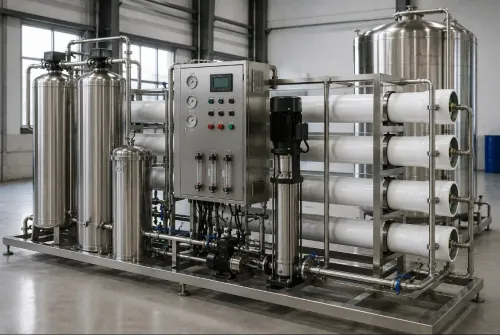
The RO plant control panel and instrumentation should show and protect the process, including:
- Feed and reject pressure, permeate and feed flow, permeate conductivity, pump overload and high-conductivity alarm
- Low-feed-pressure trip, high-pressure trip, automatic flushing, emergency stop and logged operating hours
- Permeate-tank high/low level interlocks, filtered vent, cleaning access and a specified usable volume
The quotation must also define electrical load, inlet and drain connections, reject disposal, permeate piping, tank, booster pump and commissioning tests. Otherwise you are buying a frame with a pump and membrane housings, not an operable plant.
Protect Output Through Commissioning, Operation and Maintenance
Approve the skid only through a witnessed RO acceptance test. Record feed conductivity, feed temperature, operating pressure, recovery, permeate flow, concentrate flow and permeate conductivity at the same time. A 1,000 LPH claim is not reproducible without those readings.
Require the result as temperature-normalized permeate flow, using the membrane manufacturer’s correction method and stated test conditions. Cold feed water reduces actual production, while fouling, pressure loss and membrane age reduce it further. Compare permeate quality with the agreed conductivity or salt-rejection limit; flow rating alone does not guarantee TDS reduction.
Keep a daily operating log and trend these readings against the commissioning baseline:
- Feed and permeate conductivity
- Feed, concentrate and permeate pressure
- Differential pressure across the cartridge filter and membrane array
- Actual permeate and concentrate flow
- Feed temperature and recovery
Program automatic flushing at start-up, shutdown and the intervals specified for the membrane and feed water. It clears concentrated salts from the membrane surface; disabling it can accelerate scaling.
Start CIP cleaning when the documented alarm limit for differential pressure or temperature-normalized permeate flow is reached, or when permeate conductivity rises beyond its limit. Use the approved chemical, concentration, temperature, contact time and rinse endpoint, and record each cleaning. Waiting for severe flux loss makes fouling harder to remove.
Replace membranes when cleaning no longer restores normalized flow or rejection, or when the manufacturer’s performance limit is reached. Investigate leaking seals and fittings before approving membrane replacement.
Choose the Capacity and Quotation That Fit the Whole Site
A 1000 LPH configuration is the right purchase when your sustained permeate demand is near 1,000 litres per hour and a storage tank can absorb short demand peaks. At 60% recovery, that rating means 1,667 L/h of feed and 667 L/h of concentrate, not 1,000 L/h entering the plant.
| Option | Best fit | Main trade-off |
|---|---|---|
| 500 LPH | Smaller, intermittent demand | Longer recovery time and less peak capacity |
| 1000 LPH | Regular demand around 1,000 L/h | Requires adequate feed, drain and storage capacity |
| 2000 LPH | High demand or future expansion | Higher capital, energy and reject-water volumes |
Require temperature-normalized permeate flow at stated feed TDS, temperature, recovery, pressure and membrane model. Brackish-water RO commonly operates around 10–20 bar; seawater RO needs roughly 55–70 bar, so motor horsepower alone cannot compare quotations.
Your quotation must state:
- RO permeate storage tank sizing, usable volume, level interlocks, filtered vent, cleaning access and distribution-pump duty.
- Reject-water disposal and reuse route, including drain capacity and permissions.
- Wetted material grades, such as 304 or 316L, plus valve, fastener, manifold and weld specifications.
- Pretreatment, instruments, controls, installation, testing, commissioning, consumables and exclusions.
- Expected membrane replacement interval, power consumption and maintenance assumptions for comparing RO lifecycle cost.
Ask NEEL GUARD AQUA SYSTEMS to separate equipment price from site work, taxes, freight and optional UV or sanitization so competing offers are genuinely comparable.
Related product
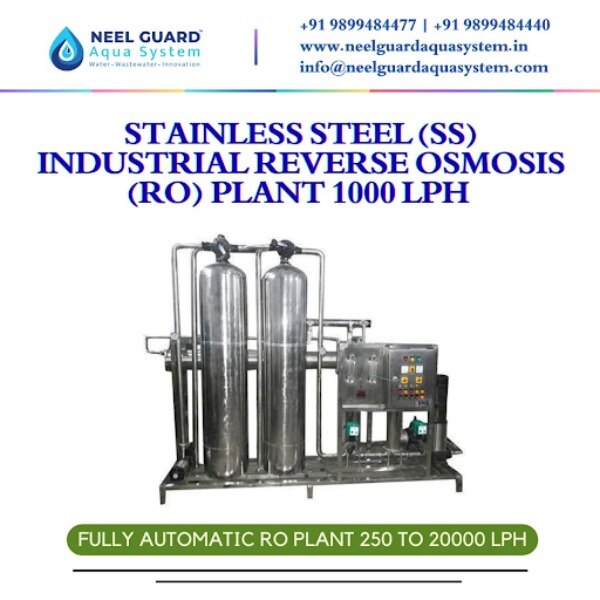
 | REVERSE OSMOSIS (RO) PLANTS STAINLESS STEEL INDUSTRIAL RO PLANT 1000 LPH ₹350000 Neel Guard Aqua Systems proudly presents the 1000 LPH Stainless Steel (SS) Industrial Reverse Osmosis (RO) Plant, designed for industries and... View product → |
Frequently asked questions
How much feed water does a 1000 LPH RO plant need?
At 60% recovery, it needs about 1,667 litres per hour of feed water and produces approximately 667 litres per hour of reject water.
How do you choose pretreatment for a 1000 LPH RO plant?
Test the source water first, then select equipment for turbidity, hardness, iron, manganese, chlorine, silica, TDS and microbial risks.
What should a stainless steel industrial RO plant quotation specify?
Request the stainless-steel grade, membrane make and model, pump details, recovery, controls, instrumentation, installation scope and commissioning services.
How do you protect a 1000 LPH RO plant during operation?
Commission it against measured flow and water quality, monitor pressure and conductivity, follow membrane cleaning intervals and keep replacement records.