A 200 KLD rating describes hydraulic capacity, not whether a plant can handle your wastewater chemistry or production pattern. You will be able to identify suitable industries, calculate the real effluent flow, match pollutants to treatment stages, and decide what testing and design information to demand before selecting a plant.
Key takeaways
- Measure actual effluent flow before selecting a 200 KLD ETP.
- Test BOD, COD, TSS, pH, oil, metals, and process-specific pollutants.
- Match treatment stages to contaminants, not industry name alone.
- Confirm design flow, outlet limits, guarantees, testing, and after-sales support.
Which industries commonly fit a 200 KLD ETP?
A 200 KLD ETP suits factories that discharge about 200,000 litres daily, not merely those that consume that volume. The most common 200 KLD ETP industries include textile dyeing, food and beverage processing, dairy, distilleries, pharmaceuticals, tanneries, paper and pulp, chemicals, electroplating, metal finishing, automotive manufacturing, refineries, and slaughterhouses.
| Industry | Main pollutants | What determines suitability |
|---|---|---|
| Textile dyeing and finishing | Colour, refractory COD, surfactants, salts, variable pH | Biological treatment alone rarely works; physico-chemical treatment and, for reuse, membranes, carbon, or oxidation may be needed |
| Food, beverage, dairy, and slaughterhouses | High BOD, fats, oil, grease, blood, suspended solids | Screening, grease removal or flotation, equalization, and biological treatment must absorb washdown shock loads |
| Pharmaceutical and bulk-drug plants | Solvents, active ingredients, high TDS, inhibitory COD | Compound-specific testing may require segregation, solvent recovery, adsorption, oxidation, or membranes |
| Electroplating, metal finishing, batteries, and chemicals | Chromium, nickel, cyanide, acids, alkalis, and metal-bearing rinses | Separate incompatible streams and chemical precipitation often matter more than biological treatment |
| Paper, pulp, tanneries, refineries, and automotive units | Colour, fibres, sulphide, chromium, oil, hydrocarbons, and variable COD | Pretreatment and toxicity control determine whether downstream biology remains stable |
A 200 KLD rating does not guarantee suitability. Check peak hourly flow, batch discharges, seasonal production, shutdown periods, and shock loads alongside daily volume. Pharmaceutical effluent and textile dyeing wastewater demand different treatment from food processing wastewater, even at the same flow.
How do you verify that the factory really produces 200 KLD of effluent?
Verify it with a measured water balance, not the inlet-water bill. A 200 KLD rating means 200,000 litres per day of average effluent flow; it does not mean the factory purchasing that volume sends it to the ETP.
Your effluent flow calculation should cover these measurements:
- Install calibrated flowmeters on process drains and the final collection line. Use a weir or flume with level logging for open channels.
- Record incoming water separately for production, domestic use, cooling, and utilities.
- Measure cooling tower blowdown and boiler blowdown instead of estimating them from make-up water.
- Track RO reject, washing operations, tank draining, and any wastewater sent by tanker.
- Subtract water incorporated into products, lost through evaporation, used for gardening, or diverted for reuse.
- Log readings at least hourly during production and during every batch discharge.
Reconcile the daily total against production records and tank volumes. A production day can produce a large batch discharge, while a shutdown can produce almost none; averaging monthly water bills hides both events. Measure at peak production and across wet-season or seasonal changes.
A 200 KLD plant averages about 8.33 m³ per hour over 24 hours. Compare that figure with the measured maximum hourly flow and the largest simultaneous discharge, not only the daily average.
If the total is below 200,000 litres but a batch arrives in one hour, provide equalization rather than assuming spare daily capacity will absorb the shock.
What wastewater tests reveal whether 200 KLD is enough?
A 200 KLD rating confirms hydraulic volume, not pollutant capacity. At 200,000 litres per day, every 1,000 mg/L of COD adds 200 kg of daily COD load, so compare measured loads with the biological and chemical stages—not flow alone.
ETP influent testing should include representative composite samples, plus grab samples during cleaning, production changeovers and batch discharge. Compare these measurements:
| Test | What it reveals | Warning sign |
|---|---|---|
| BOD, COD and BOD/COD ratio | Organic load and biodegradability | High COD with low BOD |
| TSS, oil and grease | Solids, fat and oil burden | Sudden peaks that can smother or poison biomass |
| TDS, conductivity, chloride and sulphate | Salinity and osmotic stress | Rising conductivity or salt concentration |
| pH, temperature and alkalinity | Chemical stability and biological operating range | Large pH swings or inadequate alkalinity |
| Heavy metals in effluent | Toxicity to microbes and discharge risk | Chromium, nickel, copper, zinc, mercury or lead |
| Solvents, phenols, surfactants and specific chemicals | Inhibition and refractory pollutants | Toxicity despite moderate BOD |
Use biodegradability testing, respirometry or a laboratory treatability study when COD is high but BOD is low. Test separate streams where metal-bearing rinses, solvents, concentrated brine or paint waste enter the drain; dilution in a composite sample can hide a lethal shock load.
Repeat sampling across production cycles and calculate both average and peak kg/day loads before accepting 200 KLD as adequate.
Which treatment train matches each industry’s pollutant profile?
Match the ETP treatment process to the pollutant, not merely to the daily flow.
| Industry | Main pollutant profile | Suitable treatment train |
|---|---|---|
| Food, beverage, dairy, slaughterhouse | Blood, fats, oil, high BOD, washdown shocks | Coarse screening, grease removal or dissolved-air flotation, equalization tank, coagulation flocculation when needed, biological treatment for industrial wastewater, filtration, disinfection, and biological-sludge dewatering |
| Textile dyeing and finishing | Colour, refractory COD, surfactants, salts, variable pH | Screening, equalization, pH correction, coagulation flocculation, biological treatment, pressure filtration or activated carbon; add advanced oxidation or membranes for difficult colour and reuse |
| Electroplating and metal finishing | Chromium, nickel, other metals, acids, alkalis, oil | Stream segregation, screening, chemical reduction or oxidation, pH-controlled metal precipitation, clarification, filtration, and hazardous sludge handling; do not send these streams directly to biology |
| Pharmaceutical and chemical plants | Solvents, active compounds, inhibitory COD, high dissolved solids | Source segregation, solvent recovery, chemical treatment, biological treatment after toxicity control, activated carbon, advanced oxidation, membranes, and controlled sludge disposal |
| Automotive and engineering units | Oil, paint residues, phosphating chemicals, metal-bearing wash water | Oil separation or flotation, equalization, coagulation flocculation, clarification, filtration, biological treatment only after pretreatment, then disinfection if required |
Screening protects pumps, while equalization dampens batch discharges and production washdowns. Use ultrafiltration or reverse osmosis when the discharge or reuse limit demands dissolved-solids removal; disinfect with ultraviolet or chlorination when pathogens matter.
Dewater chemical and biological sludge separately when their disposal routes differ. A combined sludge line can contaminate otherwise reusable biosolids.
What should you confirm before choosing a 200 KLD ETP supplier?
Confirm the supplier’s design basis, hydraulic calculations, consent mapping, and operating terms before signing. A 200 KLD label does not prove that the plant will handle your discharge pattern or pollutant load.
| Document or check | Evidence to request | What failure indicates |
|---|---|---|
| ETP design criteria | Process-flow diagram, mass balance, influent assumptions, equipment datasheets, P&ID, hydraulic profile, layout, power load, and sludge estimate | The quoted capacity lacks a traceable engineering basis |
| Hydraulics | Average flow, peak hourly flow, batch-discharge calculation, equalisation-tank volume, and seasonal production scenario | The plant could overflow during shifts even if daily flow is 200 m³ |
| Pollution Control Board consent | Consent to Establish or Operate, discharge route, outlet limits, monitoring frequency, and reuse conditions mapped to each treatment stage | The design may meet flow but fail a permitted COD, colour, metal, or TSS limit |
| Operating commitment | Guaranteed outlet parameters, commissioning procedure, operator training, chemical and power assumptions, preventive-maintenance schedule, spares, sludge handling, and response time | You inherit a plant that works only with undocumented effort |
Check whether the supplier has priced segregation and pretreatment for oily, metal-bearing, toxic, saline, or high-strength streams. Ask how it will manage shutdowns and shock loads, not only normal flow.
Whether you approach NEEL GUARD AQUA SYSTEMS or another ETP supplier Delhi, make every guarantee part of the purchase order and tie acceptance testing to agreed influent and treated-water samples.
Related product
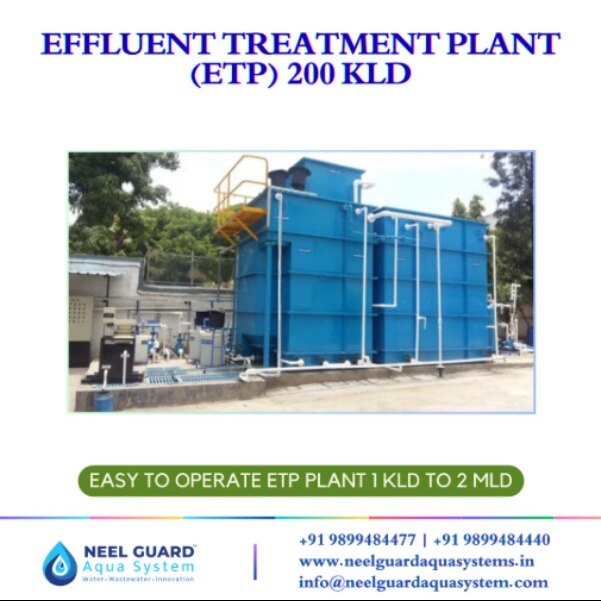
 | EFFLUENT TREATMENT PLANT (ETP) EFFLUENT TREATMENT PLANT 200 KLD ₹3800000 The 200 KLD Effluent Treatment Plant (ETP) is a high-performance wastewater treatment solution designed to treat and recycle industrial effluent... View product → |
Frequently asked questions
Which industries commonly fit a 200 KLD ETP?
Textile dyeing, food and beverage, dairy, distilleries, pharmaceuticals, tanneries, paper and pulp, chemicals, electroplating, metal finishing, automotive, refineries, and slaughterhouses can fit when their measured effluent flow is close to 200,000 litres daily.
How do you verify that a factory really produces 200 KLD of effluent?
Measure inlet flow with a calibrated flow meter across representative production days, record operating hours and batch discharges, and compare the total effluent volume with water-use records.
What wastewater tests reveal whether 200 KLD is enough?
Test flow, pH, temperature, BOD, COD, TSS, TDS, oil and grease, colour, nitrogen, phosphorus, sulphide, heavy metals, and industry-specific chemicals before finalising capacity.
Which treatment train matches each industry's pollutant profile?
Use screening and equalisation first, then select biological treatment for biodegradable organics, chemical treatment for colour or metals, dissolved air flotation for oils and solids, and tertiary treatment for reuse or strict discharge limits.
What should you confirm before choosing a 200 KLD ETP supplier?
Confirm the design basis, peak-flow allowance, inlet and outlet guarantees, equipment specifications, civil and electrical scope, sludge handling, commissioning tests, operator training, spares, warranty, and service response.