
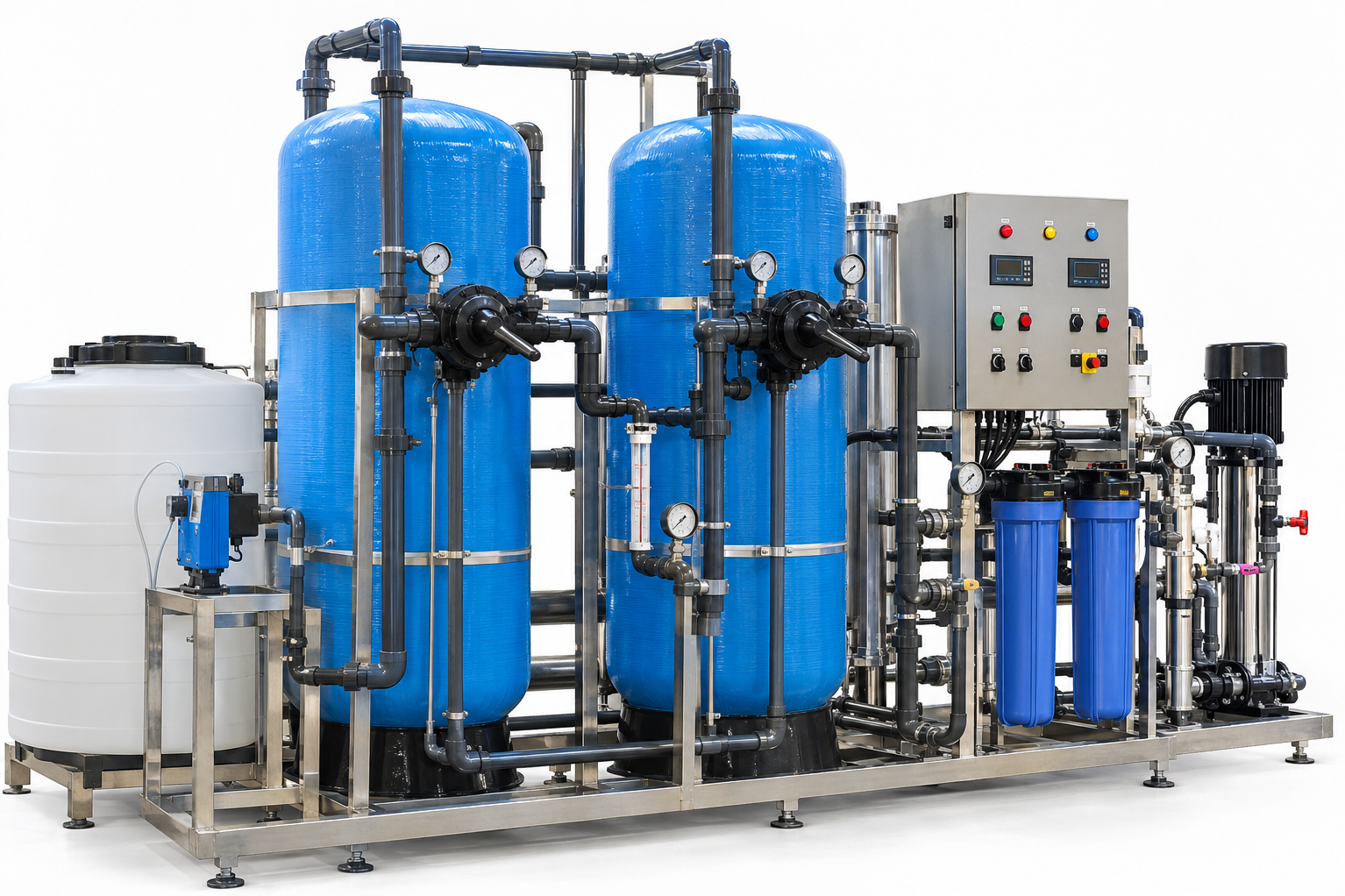
Choosing a DM Plant requires a clear understanding of the water quality needed by the process. Demineralization systems are used when dissolved ionic impurities need to be reduced to achieve water quality beyond what conventional filtration alone can provide.
For manufacturing facilities in Delhi, DM water may be required for boilers, process preparation, laboratories, pharmaceutical applications, chemical manufacturing, plus other operations where mineral content can interfere with production or equipment performance.
Begin With the Required Output Quality
A common purchasing mistake is to start with equipment capacity rather than treated-water specifications.
Before comparing DM systems, define parameters such as:
- Required conductivity
- Required silica level
- Daily water consumption
- Peak flow
- Feed-water TDS
- Regeneration frequency expectations
- Available operating hours
- Storage requirements
The appropriate treatment configuration depends heavily on these values.
Examine the Feed Water
Raw-water chemistry determines the ionic load reaching the system.
Hardness, alkalinity, chlorides, sulphates, silica, plus total dissolved solids influence resin loading plus regeneration requirements.
If feed water contains high suspended matter or other contaminants, suitable pretreatment may also be necessary to protect the ion-exchange system.
A supplier should therefore review a recent water analysis rather than recommending a standard plant solely from required litres per hour.
Understand the Treatment Configuration
Demineralization commonly uses ion-exchange resins to remove charged dissolved contaminants.
Depending on water-quality requirements, a system may use cation exchange, anion exchange, degassing, mixed-bed polishing, plus associated pretreatment.
Some facilities combine RO with DM treatment to reduce ionic load before demineralization. This can change chemical consumption, regeneration frequency, plus overall operating economics.
The correct arrangement depends on feed-water conditions plus the quality required at the point of use.
Consider Regeneration Requirements
Ion-exchange resins have a finite working capacity. Once exhausted, they require regeneration.
Plant evaluation should therefore include chemical storage, operator safety, regeneration procedure, wastewater generation, plus downtime.
Facilities with continuous production may need additional planning so that regeneration does not interrupt process-water availability.
Storage tanks or standby arrangements can help manage this requirement.
Look Beyond Purchase Price
Two systems with the same nominal capacity may have very different operating characteristics.
When evaluating proposals, compare:
- Resin quantity plus quality
- Vessel sizing
- Instrumentation
- Chemical consumption
- Regeneration frequency
- Automation level
- Expected operating pressure
- Maintenance access
- Service support
- Material of construction
A lower initial quotation does not necessarily mean lower lifecycle cost.
Match the System to the Industrial Application
Pharmaceutical, chemical, engineering, food-processing, plus other industries can have very different specifications for purified process water.
Boiler applications are another important example. Feed-water quality can influence scaling, deposits, blowdown requirements, plus overall boiler performance.
NEEL GUARD AQUA SYSTEMS evaluates industrial water-treatment requirements based on source-water characteristics, desired output, capacity, plus application conditions.
For facilities across Delhi plus nearby industrial regions, selecting a DM Plant should be a technical evaluation rather than a catalogue purchase.
Define the final water specification first. Analyse the feed water next. Then compare treatment configuration, regeneration requirements, operating cost, maintenance accessibility, plus capacity.
This approach makes it easier to select a demineralization system that supports actual production needs rather than simply meeting a nominal flow-rate figure.